Subscribe to receive the latest blog posts to your inbox every week.
By subscribing you agree to with our Privacy Policy.
Strong risk controls in credit line on UPI are critical for banks to manage exposure, fraud, and regulatory scrutiny.
Credit Line on UPI (CLOU) introduces a new risk profile for banks. Unlike cards or traditional loans, CLOU operates on real-time payment rails, with continuous utilisation, instant repayments, and dynamic credit exposure.
This changes the nature of risk governance.
In CLOU, controls must be enforced before authorisation, not discovered after settlement. Banks that treat CLOU like a card extension or a loan product quickly face issues—fraud spikes, delayed suspensions, reconciliation gaps, and audit observations.
This article explains how banks design issuer-grade risk controls for Credit Line on UPI, ensuring portfolio stability, regulatory compliance, and operational resilience.
This shift toward pre-authorisation enforcement mirrors how banks implement Credit Line on UPI in practice, where risk governance is embedded into issuer systems rather than managed after settlement.
CLOU combines the speed of UPI payments with the exposure of revolving credit. This creates three defining risk characteristics:
As a result, CLOU risk controls must be:
These structural differences are also why CLOU risk cannot be governed using card-centric models, a distinction explored further in multi-rail credit portfolio design on UPI.
A mature CLOU risk framework spans multiple layers, each enforcing controls at a different stage of the lifecycle.
In issuer-grade deployments, these parameters are enforced systematically through a dedicated lifecycle layer, reinforcing why banks need a Credit Line Management System for Credit Line on UPI to prevent policy drift at scale.
Risk governance begins before a single transaction occurs.
Banks define:
These parameters are configured at the credit scheme level and enforced consistently across all CLOU accounts.
This ensures policy adherence by design, not by exception handling.
In Credit Line on UPI, credit limits are living variables.
Effective controls include:
Real-time utilisation tracking
Immediate reduction of available credit post-transaction
Instant replenishment after repayment
Automated suspension when thresholds are breached
Without real-time limit enforcement, banks risk over-extension within minutes, especially during peak UPI traffic.
This real-time limit governance is only possible when risk logic is tightly coupled with the issuer stack, as defined in the issuer-side CLOU architecture
Merchant misuse is a common CLOU risk vector.
Banks mitigate this using:
MCC allowlists and blocklists
Merchant category–specific limits
Use-case-based restrictions (e.g., P2M only)
Geo or merchant-type exclusions
Because CLOU transactions are UPI-native, merchant-level controls must be enforced before authorisation, not during reconciliation.
CLOU fraud patterns differ from card fraud.
Effective controls include:
Transaction frequency caps
Daily and per-transaction value limits
Time-based velocity rules
Abnormal usage pattern detection
These controls help prevent:
Rapid limit exhaustion
Automated misuse
Coordinated fraud attempts
One of CLOU’s biggest advantages is immediate risk response.
Banks can configure:
DPD-based suspension rules
Partial or full credit freezes
Automatic reinstatement after repayment
Escalation thresholds for collections
This dynamic response is impossible with batch-driven systems and is critical for early loss containment.
Repayment behaviour is a core risk signal.
Banks manage this by:
Linking credit availability to repayment status
Enforcing minimum due amounts
Mandating UPI Autopay for higher-risk segments
Suspending further spends on missed repayments
Because repayments update limits in real time, risk posture adjusts instantly, improving both control and customer experience.
CLOU requires continuous monitoring, not periodic reviews.
Banks implement:
Transaction-level monitoring
Rule-based alerts
Manual review queues for exceptions
Rapid response playbooks for suspicious activity
This ensures issues are contained early, before they propagate across the portfolio.
Credit Line on UPI operates under:
RBI Digital Lending Guidelines
NPCI requirements
Internal audit and statutory scrutiny
Risk controls must therefore include:
Consent capture and storage
Complete transaction audit trails
Scheme-level reporting
Bureau and regulatory submissions
When controls are embedded into the issuer platform, compliance becomes continuous rather than corrective.
Banks that underinvest in CLOU risk controls often face:
At scale, these issues directly impact capital efficiency and brand trust.
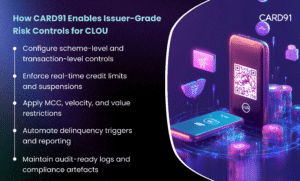
CARD91 enables banks to implement real-time, policy-driven risk controls through its unified CLOU infrastructure.
With CARD91’s platform, banks can:
This infrastructure-led approach ensures risk governance is built into the system—not managed manually.
In Credit Line on UPI, risk outcomes are determined by architecture and controls, not by post-facto reviews.
Banks that succeed with CLOU:
Strong risk controls are not a constraint on CLOU growth—they are the enabler of sustainable scale.
In effect, strong risk controls are inseparable from issuer-grade CLOU architecture, where payments, credit exposure, and compliance operate as a single, continuously governed system.
Q: What are the key risk controls in Credit Line on UPI?
A: They include real-time credit limits, MCC restrictions, velocity controls, delinquency triggers, and regulatory reporting.
Q: How is CLOU risk different from card risk?
A: CLOU risk is account-based and real-time, while card risk is card-centric and often batch-governed.
Q: Can banks suspend Credit Line on UPI instantly?
A: Yes. With the right platform, banks can suspend or reinstate credit lines dynamically based on risk triggers.
Looking to strengthen risk governance for Credit Line on UPI?
See how CARD91’s CLOU infrastructure enables real-time controls, compliance, and portfolio stability. Book a Demo


To know more about our offerings connect with our experts