Subscribe to receive the latest blog posts to your inbox every week.
By subscribing you agree to with our Privacy Policy.
Real-time payments, embedded lending, and continuous risk monitoring are changing what financial institutions need from their operating stack. AI is no longer being evaluated only as an overlay for analytics or automation. It is increasingly being assessed as part of the infrastructure that supports live financial decision-making.
That shift matters because payments, lending, and risk workflows now run with far less tolerance for delay, weak controls, or fragmented visibility. For banks, NBFCs, and fintechs, the key question is no longer whether AI can add value. It is whether AI can be embedded into production systems in a way that supports speed, governance, traceability, and policy-led execution.
This is where AI infrastructure for financial institutions becomes a useful evaluation category.
CARD91’s AI Lab reflects this infrastructure-led approach through capabilities built around AI-led fraud detection, real-time risk monitoring, merchant verification and classification, and behaviour-based credit assessment for regulated financial institutions operating within RBI- and NPCI-aligned environments.
AI infrastructure for financial institutions should be understood as intelligence embedded into financial operating systems rather than added as a disconnected analytics layer.
In practice, this means infrastructure that can support:
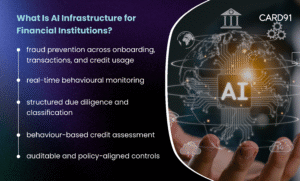
This is also the lens through which CARD91’s AI Lab presents its value proposition: early fraud prevention, real-time risk monitoring, enhanced due diligence, responsible credit expansion, and regulatory-grade scale.
Financial systems now operate with very little tolerance for inconsistency, latency, or weak controls.
Payment ecosystems require immediate responses to transaction and fraud signals. Merchant onboarding must remain accurate without becoming slow or operationally heavy. Lending increasingly depends on better ways to assess borrower behaviour and monitor exposure after sanction. Risk teams need visibility that goes beyond static rules and one-time checks.
In this environment, AI is valuable only when it is built into the infrastructure layer where these decisions are made.
That is what makes AI-led financial infrastructure more relevant than standalone AI tools. The real issue is not access to models. It is whether institutions have the right architecture to use intelligence in real financial operations.
For payment systems, AI infrastructure should be assessed on whether it can improve control without creating friction.
Based on CARD91’s AI Lab positioning, the platform supports early fraud prevention by helping institutions identify and mitigate fraud risks across onboarding, transactions, and credit usage through continuous, risk-based monitoring. It also supports ongoing transaction-level and behavioural risk monitoring without impacting system performance.
From an evaluation standpoint, that translates into three practical questions.
A strong payments AI layer should not be limited to post-event review. It should support risk monitoring across onboarding, live transaction activity, and downstream usage patterns.
Transaction ecosystems change in real time. Infrastructure that only validates fixed parameters may miss emerging patterns. Behaviour-led monitoring is therefore more relevant for production payment environments.
For institutions handling live payment flows, AI must support operational speed and resilience. If intelligence slows down decision-making, it becomes difficult to use at scale.
These are the kinds of functional criteria that make AI banking infrastructure commercially meaningful in payment operations.
Merchant due diligence is another area where AI infrastructure should be judged by workflow fit rather than generic AI claims.
CARD91’s AI Lab highlights enhanced due diligence through structured verification, consistent KYB classification, and periodic validation. Its Merchant Verification & Classification capability is positioned as helping issuers and acquirers reduce onboarding fraud and misclassification risk, improve KYB accuracy and consistency, detect merchant behaviour drift after activation, and accelerate merchant go-live without weakening controls.
For financial institutions, this creates three practical evaluation points.
Structured verification should reduce manual inconsistency and make onboarding more repeatable across merchant categories.
For merchant ecosystems, classification accuracy affects risk controls, routing, compliance, and commercial logic.
A merchant may appear low-risk during onboarding and still drift behaviourally over time. Post-activation monitoring therefore matters as much as initial verification.
This is where AI fintech infrastructure becomes especially relevant for acquiring and merchant-risk operations.
Lending infrastructure should be evaluated on whether AI strengthens institutional underwriting rather than replacing it.
CARD91’s AI Lab positions its lending intelligence around responsible credit expansion, including Credit Line on UPI, through usage-based assessment and exposure controls. Its UPI Credit Score Engine is described as enabling issuers to assess eligibility using UPI transaction behaviour, monitor exposure and risk continuously after sanction, support real-time credit decisions within UPI flows, and scale portfolios with disciplined, policy-driven risk controls. It is also described as designed for issuer-controlled underwriting rather than black-box scoring.
That gives lenders a clear framework for evaluation.
For many digital lending use cases, static data alone is not enough. Behavioural signals can strengthen how institutions assess creditworthiness.
Lending risk does not end at approval. Continuous monitoring matters for active credit products and portfolio quality.
This is a critical decision factor. AI should support policy execution, not replace it opaquely.
For financial institutions assessing lending infrastructure, these are the questions that make AI operationally credible.
Risk systems should be evaluated not only on detection capability, but also on governance readiness.
CARD91’s AI Lab highlights traceable, auditable controls aligned with RBI guidelines and NPCI requirements, while also positioning its AI capabilities for regulatory-grade scale.
For production financial environments, this makes a meaningful difference.
Institutions need to understand how decisions were supported, escalated, or flagged across payment and credit workflows.
In regulated environments, auditability is not optional. It is part of deployment readiness.
AI becomes more useful when it supports formal control structures rather than operating outside them.
These factors are central to evaluating whether an AI layer is suitable for regulated risk operations at scale.
Q: What is AI infrastructure in banking?
A: AI infrastructure in banking refers to intelligence embedded into core payment, risk, onboarding, and lending workflows rather than used only as a standalone analytics tool. In CARD91’s AI Lab positioning, this includes fraud prevention, real-time risk monitoring, due diligence support, merchant classification, and behaviour-based credit assessment.
Q: How does AI support payment risk monitoring?
A: AI can support payment risk monitoring by identifying risk signals across onboarding, live transactions, and credit usage through continuous, risk-based monitoring and behavioural analysis. CARD91’s AI Lab explicitly positions itself around early fraud prevention and ongoing transaction-level and behavioural risk monitoring.
Q: How does AI improve merchant verification?
A: CARD91’s Merchant Verification & Classification capability is positioned as helping reduce onboarding fraud and misclassification risk, improve KYB consistency, detect merchant behaviour drift after activation, and speed up merchant go-live without weakening controls.
Q: How does AI help lending infrastructure?
A: CARD91’s UPI Credit Score Engine is positioned as helping issuers assess eligibility using UPI transaction behaviour, monitor exposure after sanction, support real-time credit decisions inside UPI flows, and scale portfolios with policy-driven risk controls.
Q: What should financial institutions evaluate before adopting AI-led infrastructure?
A: The key questions are whether the infrastructure supports real-time operations, behaviour-based monitoring, structured due diligence, policy-led underwriting, and traceable controls suitable for regulated deployment. These are the capability areas highlighted across CARD91’s AI Lab stack.
For banks, NBFCs, and fintechs, AI is becoming less of a standalone technology layer and more of an infrastructure decision.
That is why AI infrastructure should be evaluated in terms of operational fit across payments, due diligence, lending, and risk. The most relevant questions are practical ones: whether the infrastructure can support continuous monitoring, improve verification and classification quality, strengthen policy-led credit decisioning, and provide traceable controls in regulated environments.
Viewed through that lens, infrastructure-led AI is not simply about adding intelligence. It is about making financial systems more responsive, more controlled, and more ready for real-world deployment. Explore AI Infrastructure


To know more about our offerings connect with our experts