Subscribe to receive the latest blog posts to your inbox every week.
By subscribing you agree to with our Privacy Policy.
AI financial decision engines are becoming a core infrastructure layer in modern financial systems, enabling banks and NBFCs to automate decision-making across onboarding, credit underwriting, and risk workflows.
At a fundamental level, these systems combine verification data, risk signals, and policy logic to produce real-time, consistent, and auditable decisions. Instead of relying on fragmented checks and manual reviews, institutions can move toward structured, infrastructure-led decision automation.
As digital onboarding and real-time payment ecosystems scale, AI decision automation in finance is no longer optional—it is a requirement for controlled and scalable decisioning.
AI financial decision engines automate decision-making across financial workflows by integrating data, verification, scoring, and policy rules into a unified system.
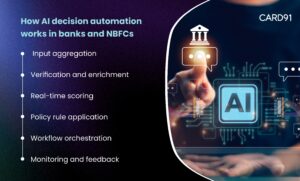
In practical terms, this explains how AI decision engines work in banking. They operate across:
Instead of isolated processes, these engines create a single decisioning layer that:
The output is not just a score—it is a decision outcome: approve, review, or reject.
This distinction is critical. A scoring model provides an estimate. A decision engine executes an action within a governed workflow.
Traditional decision-making systems were built for lower volumes and manual processing. As financial ecosystems evolve, these systems struggle to support real-time, high-volume decisioning.
Key limitations include:
Fragmented data inputs
Verification and risk signals are distributed across systems, requiring manual consolidation before decisions
Static rule frameworks
Predefined thresholds fail to adapt to behavioural signals or contextual risk patterns
Inconsistent policy application
Manual decisioning leads to variation across teams, products, and geographies
Delayed decision timelines
Sequential workflows slow onboarding, underwriting, and approval processes
Limited fraud visibility
Risk signals are often detected late, especially during onboarding before account activation or credit approval
These constraints lead to:
At scale, these inefficiencies compound, making modern financial operations difficult to manage.
AI decision automation in finance follows a structured, policy-driven process that enables consistent and real-time decisioning.

For example, during digital onboarding, an AI decision engine can simultaneously evaluate identity verification signals, transaction behaviour, and policy thresholds to determine whether an applicant should be approved, flagged for review, or declined in real time.
This structured approach ensures that decision automation for NBFC onboarding and banking workflows is:
A scalable AI financial decision engine is built on interconnected infrastructure layers:
Unified verification layer
Aggregates signals from identity, financial, and behavioural data sources into a single verification flow
Confidence scoring engine
Converts fragmented verification inputs into structured risk or confidence scores
Policy rules engine
Defines thresholds, eligibility criteria, and decision logic aligned with institutional risk strategies
Workflow orchestration layer
Automates routing of decisions into operational workflows with minimal manual intervention
Monitoring and audit layer
Tracks decision outcomes, ensures auditability, and supports regulatory compliance
These components enable automated financial decision workflows that are both scalable and controlled.
AI financial decision engines create measurable value across key financial workflows:
Onboarding and verification
Credit underwriting
Merchant onboarding and monitoring
Transaction risk monitoring
Operational efficiency
Across these use cases, AI decision automation finance improves both speed and decision quality without compromising control.
The effectiveness of AI financial decision engines depends on the infrastructure that connects data, scoring, policy logic, and workflows into a unified system.
A standalone scoring model generates a risk estimate. It does not:
These are infrastructure functions—and they determine whether decisioning is operationally effective.
For banks and NBFCs, infrastructure for AI decisioning ensures:
CARD91’s infrastructure-first approach reflects this shift. Through its AI Lab, solutions such as VerifyIQ (verification intelligence), BlitzScore (behavioural credit scoring), and BlitzTrust (merchant verification and classification) function as modular intelligence layers embedded within financial systems.
This enables institutions to adopt AI-led risk decisioning without rebuilding their entire stack, while ensuring decisions remain governed, traceable, and aligned with policy.
AI financial decision engines are redefining how banks and NBFCs manage onboarding, risk, and credit decisions at scale.
Their value lies not just in automation, but in enabling structured, infrastructure-led decisioning that combines verification, scoring, policy control, and workflow orchestration into a unified system.
As financial systems become faster and more complex, AI decision automation in finance is no longer optional—it is foundational infrastructure for consistent, scalable, and risk-aligned decision-making.
For institutions modernising their operations, the focus should be on building decision systems that are governed, adaptable, and designed for real-world financial risk.
Q: What are AI financial decision engines?
A: AI financial decision engines are systems that automate financial decision-making by combining verification data, risk scoring, policy rules, and workflow orchestration into a unified decision layer.
Q: How do AI decision engines work in banking?
A: They aggregate data, verify inputs, generate real-time risk scores, apply policy rules, and route decisions into approve, reject, or review workflows.
Q: How are AI decision engines different from scoring models?
A: Scoring models provide risk estimates, while decision engines convert those scores into structured, policy-aligned outcomes within operational workflows.
Q: Why is decision automation important for NBFCs?
A: Decision automation for NBFCs improves speed, consistency, and scalability while reducing manual effort and operational inefficiencies.
Q: What is AI decision automation in finance?
A: AI decision automation in finance refers to using AI-driven systems to automate risk evaluation and decision-making across onboarding, lending, and transaction workflows.
Q: How do AI decision engines improve fraud detection?
A: They analyse multiple signals in real time, helping identify anomalies early—especially during onboarding and transaction processing.
Q: Why is infrastructure important for AI decisioning?
A: Infrastructure ensures that decision systems are scalable, integrated, auditable, and capable of applying consistent policy logic across all workflows.
Explore how CARD91 enables infrastructure-led AI decision automation for banks and NBFCs.
To know more about our offerings connect with our experts
Sales: sales@card91.io
HR: careers@card91.io
Media: comms@card91.io
Support: support@card91.io