Subscribe to receive the latest blog posts to your inbox every week.
By subscribing you agree to with our Privacy Policy.
In Digital Lending, Delayed Risk Evaluation Is No Longer an Operational Gap—It Is an Infrastructure Weakness
Digital lending has evolved into a real-time operating environment. Applications are processed faster, credit journeys are increasingly embedded into digital payment flows, and borrower behaviour continues to shift across dynamic transaction ecosystems.
However, in many institutions, risk assessment still depends on fragmented systems, sequential checks, and delayed workflows that were not designed for real-time lending environments.
This creates a structural mismatch. When lending operates at transaction speed but risk evaluation remains delayed, institutions are left making decisions on incomplete visibility, inconsistent workflows, and outdated signals.
Modern digital lending increasingly depends on real-time infrastructure, where systems are designed to support faster decisioning without compromising operational control.
For banks and NBFCs, real-time risk assessment is no longer simply a better way to underwrite. It is becoming a core infrastructure requirement for scalable, controlled, and decision-ready digital lending.
Real-time risk assessment refers to the continuous evaluation of borrower risk using live inputs, behavioural signals, policy-led decision logic, and workflow-based routing across the lending lifecycle.
Unlike traditional models that rely on static or point-in-time evaluation, real-time systems are designed to assess risk dynamically at key stages such as onboarding, underwriting, credit usage, and ongoing monitoring.
In practical terms, this means moving from isolated checks to a more integrated decisioning environment where multiple signals can be evaluated together, thresholds can be applied consistently, and outcomes can be routed through structured workflows.
This is where AI lending infrastructure becomes increasingly relevant, as it enables risk assessment to operate within a more integrated and scalable decisioning environment. In parallel, AI loan risk assessment helps improve decision quality by bringing intelligence, structure, and consistency into the evaluation process.
Digital lending no longer operates in slow, linear cycles. As credit journeys become faster and more embedded into digital ecosystems, the underlying risk infrastructure must evolve accordingly.
Risk Is Not Static
Borrower behaviour does not remain fixed after initial evaluation. A one-time score cannot fully represent a borrower’s evolving profile in a real-time lending environment.
Lending Workflows Are Increasingly Time-Sensitive
Modern lending systems are expected to support faster decisions without sacrificing structure or control. As workflows accelerate, institutions require stronger risk decisioning systems that can support structured and consistent evaluation at scale.
Earlier Risk Visibility Improves Control
Delayed risk evaluation often means institutions detect issues only after exposure has already increased. Real-time assessment improves visibility into signals earlier in the workflow.
Decision Quality Depends on Workflow Alignment
Even strong risk logic can underperform if it sits outside the operational workflow. Real-time systems bring decision logic, policy thresholds, and process routing into the same environment.
Scalable Lending Requires Scalable Risk Infrastructure
As banks and NBFCs expand digital lending operations, fragmented processes become increasingly difficult to manage. Infrastructure-led risk assessment supports scale without increasing operational complexity.
The difference between traditional and real-time approaches is not merely one of speed. It is architectural.
Traditional Risk Evaluation
Traditional models often rely on point-in-time checks, separate verification steps, and sequential decision flows. While operationally functional, they struggle to support the speed, consistency, and visibility required in modern lending environments.
Typical limitations include:
Real-Time, Infrastructure-Led Risk Evaluation
A real-time approach is built around integrated systems that support continuous signal evaluation, behavioural insight, policy-led routing, and structured workflows.
This enables:
Many institutions operate with risk processes that are technically functional but structurally misaligned with modern lending requirements.
Siloed Verification Creates Incomplete Visibility
When verification signals are distributed across disconnected systems, institutions struggle to build a complete and consistent view of borrower risk.
Sequential Workflows Slow Down Decisioning
Where checks happen sequentially rather than within a unified flow, decision speed reduces and operational dependency increases.
Limited Monitoring Weakens Lifecycle Risk Management
In many systems, risk evaluation is concentrated at origination, creating blind spots across the broader credit lifecycle.
Disconnected Decision Layers Reduce Consistency
When models, policy rules, and workflows operate independently, outcomes become inconsistent and harder to govern.
AI Without Workflow Integration Delivers Limited Impact
Adding intelligence without integrating it into workflows improves scoring but does not enable real-time decisioning.
Real-time risk assessment depends on infrastructure that connects data, intelligence, rules, and workflows into a unified system.
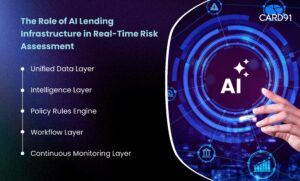
Unified Data Layer
A single system aggregates inputs to provide more consistent and complete visibility.
Intelligence Layer
This is where AI loan risk assessment becomes meaningful, enabling better interpretation of behavioural and transactional signals.
Policy Rules Engine
Institutions can define and apply thresholds, eligibility criteria, and decision logic consistently across workflows.
Workflow Layer
Risk outcomes are translated into structured actions such as approval, review, or rejection.
Continuous Monitoring Layer
Risk evaluation extends beyond onboarding to support lifecycle-based monitoring and control.
Together, these layers define modern AI lending infrastructure, where risk decisioning is embedded directly into operations.
Modernising risk assessment requires a shift from tool-based thinking to infrastructure-led design.
A structured approach includes:
Institutions that invest in a more integrated lending decisioning environment are better positioned to scale with consistency, visibility, and control.
When intelligence is embedded into infrastructure, decision-making becomes more structured and reliable.
This alignment between intelligence and operations is essential for modern digital lending.
Faster Decisioning
Integrated systems support quicker evaluation and reduced delays.
Improved Risk Control
Earlier visibility enables better management of exposure.
Reduced Operational Burden
Workflow automation reduces reliance on manual processes.
More Consistent Outcomes
Policy-led decisioning ensures uniform application of risk logic.
Greater Scalability
Infrastructure supports growth without fragmentation.
Stronger Governance
Integrated systems improve traceability and alignment with internal frameworks.
Digital lending has already become real time. Risk assessment must evolve accordingly.
Banks and NBFCs that continue to rely on delayed or fragmented systems will face increasing challenges in maintaining decision quality and operational consistency.
Those that adopt AI lending infrastructure can unify risk signals, enable real-time decisioning, and scale lending operations with greater control.
This is not simply a shift from manual to automated underwriting. It is a transition toward decision-ready infrastructure built for modern digital lending.
Q: What is real-time risk assessment in digital lending?
A: Real-time risk assessment is the continuous evaluation of borrower risk using live data, behavioural signals, and policy-driven workflows across the lending lifecycle.
Q: How does AI lending infrastructure support risk assessment?
A: It connects data, intelligence, policy rules, and workflows into a unified system that enables faster and more consistent decision-making.
Q: What is the difference between credit scoring and AI lending infrastructure?
A: Credit scoring produces a risk output, while AI lending infrastructure operationalises that output within workflows, rules, and lifecycle decisioning.
Q: Why is real-time risk assessment important for banks and NBFCs?
A: It improves decision speed, enhances risk visibility, ensures consistency, and supports scalable lending operations.
Q: What are the risks of delayed risk assessment?
A: Delayed systems lead to incomplete visibility, inconsistent decisions, operational inefficiencies, and higher exposure to risk.
Build real-time, risk-aware lending systems with CARD91. Explore how AI-led infrastructure can unify verification, decisioning, and risk intelligence into a single scalable workflow.


To know more about our offerings connect with our experts