Subscribe to receive the latest blog posts to your inbox every week.
By subscribing you agree to with our Privacy Policy.
Most onboarding flows are built to complete checks.
Stronger onboarding flows are built to support decisions.
That difference matters.
For banks, NBFCs, and insurers, onboarding does not break only when checks are missing. It also breaks when completed checks do not translate into the right next action. Cases move too slowly, review queues expand, and low-risk applications face the same friction as cases that genuinely need closer scrutiny.
This is why onboarding design matters.
A risk-aligned onboarding flow is not just a faster flow. It is a flow that applies the right level of friction, review, and decisioning based on the strength, clarity, and relevance of the available signals.
A risk-aligned onboarding flow is a workflow that routes cases based on signal quality, decision readiness, and risk context instead of relying only on check completion or review-by-default logic.
In practical terms, the flow is designed to answer one question clearly:
What should happen next for this case, given everything the system now knows?
That matters because onboarding is not only about collecting inputs. It is about turning those inputs into action.
A well-designed risk-aligned onboarding flow helps institutions:
Many onboarding systems still operate like checklists.
They confirm whether documents were uploaded, whether KYC was completed, whether certain rules passed, and whether required fields were filled.
But even after that, the workflow may still not know what to do with enough clarity.
That is where the breakdown begins.
A case may complete verification and still move to manual review. Another may have one weak signal and get treated with the same friction as a genuinely risky case. In other situations, good cases may slow down simply because the workflow is not designed to interpret signals in context.
This is why onboarding friction is often not just a verification issue.
It is a flow design issue.
For a deeper view of that gap, see Why BFSI Onboarding Still Depends on Manual Reviews — And What Needs to Change
A risk-aligned onboarding flow is built around interpretation, routing, and actionability.
That usually requires five things.
1. Signal collection is not enough
The flow should not stop at capturing documents, identity inputs, business details, and supporting data. It should also be able to interpret how those signals fit together.
2. Verification must connect to decisioning
Verification confirms inputs. Decisioning determines what should happen next. If the workflow ends at verification, review dependency usually increases.
This is also why verification, risk scoring, and decisioning should not be treated as the same layer.
3. Risk should not be inferred from uncertainty alone
Not every incomplete or unclear case is unsafe. Good onboarding design separates low clarity from real risk.
4. Manual review should be selective
Human review should support true exceptions, not function as the default fallback for every imperfect case.
5. Routing should reflect decision readiness
The key question is not only whether checks passed. It is whether the case is strong enough to approve, weak enough to reject, or unclear enough to review or re-verify.
Checklist-led onboarding works well for completion tracking.
It does not work as well for decision quality.
That is because a checklist can confirm that a case has gone through the required steps, but it does not always explain whether the case should move forward, pause, escalate, or return for clarification.
This is why many BFSI teams still face:
A risk-aligned onboarding flow solves for these issues by shifting from check completion to decision readiness.
A well-designed onboarding flow usually includes these core layers: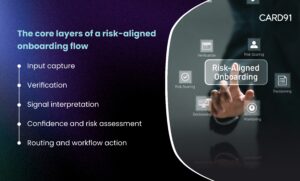
1. Input capture
Collect identity details, documents, business information, and other required inputs.
2. Verification
Validate the submitted information through identity checks, document checks, supporting signal checks, and fraud-related controls.
3. Signal interpretation
Evaluate how the available signals relate to each other instead of treating each one in isolation.
4. Confidence and risk assessment
Determine whether the case is strong enough to act on, risky enough to restrict, or unclear enough to review further.
This is where confidence scoring in BFSI onboarding becomes useful. It helps assess whether available signals are strong enough to support action, not just whether a case appears risky.
5. Routing and workflow action
Push the case into the right next step: approve, review, reject, or re-verify.
That is what makes the flow risk-aligned.
It is not only verifying more. It is routing better.
A weak onboarding flow usually shows up in one of these ways:
Review-by-default logic
Cases go to human reviewers because the workflow cannot interpret them clearly enough upstream.
Overreaction to single weak signals
One mismatch or incomplete field triggers the same friction as a materially risky case.
No distinction between low confidence and high risk
The workflow treats uncertainty as danger instead of separating the two.
Fragmented signal handling
Verification outputs sit across different tools or rules layers without one clear interpretation layer.
This is the same issue explored in fragmented verification in BFSI onboarding.
Inconsistent operational action
Similar cases get routed differently depending on reviewer judgment or team bandwidth.
These are not just process issues. They directly affect onboarding speed, efficiency, and control.
Banks, NBFCs, and insurers with stronger onboarding flows usually do four things better.
1. They unify signals before action is taken
They do not rely on isolated checks to determine workflow outcomes.
This is where verification intelligence in onboarding becomes important. The goal is not just to run checks, but to bring signals into one clearer decision-ready layer.
2. They reduce unnecessary friction for good cases
They avoid slowing low-risk, decision-ready cases just because one signal is imperfect.
This also helps reduce false positives in digital onboarding.
3. They reserve manual review for true exceptions
They make review capacity more valuable by using it selectively.
4. They build routing logic around actionability
Their workflows are designed to answer what should happen next, not only what checks were completed.
Verification intelligence helps move onboarding from fragmented validation to decision-ready routing.
Instead of treating verification as a set of disconnected checks, it brings multiple signals into one clearer operational layer. That makes it easier to understand whether a case is truly risky, simply incomplete, or ready to move.
This is especially important in onboarding flows where the institution needs to:
That is also why verification intelligence matters beyond basic KYC. It improves the quality of workflow action after checks are complete.
Confidence-led routing improves onboarding by assessing whether the available signals are strong enough to support action.
That distinction matters because many onboarding delays are caused by low clarity rather than high risk.
A risk-aligned flow should be able to separate:
When those distinctions are clear, routing becomes more precise.
That helps institutions move good cases faster while still applying the right controls to cases that need more attention.
Consider two onboarding cases.
Case A
The applicant completes KYC, identity details align, document quality is acceptable, and supporting signals are largely consistent. One field is incomplete, but the broader profile remains strong.
Case B
The applicant completes KYC, but multiple supporting signals are inconsistent, some fields are incomplete, and one pattern suggests higher review priority.
A checklist-led flow may treat both cases with similar friction.
A risk-aligned onboarding flow should not.
Case A may require minimal intervention or targeted clarification. Case B may require review, stricter routing, or additional verification.
That is the difference between check completion and flow design.
CARD91’s VerifyIQ is built around this operational gap.
It is designed to bring fragmented verification signals into a clearer onboarding flow so institutions can move from completed checks to more structured and confident action.
For banks, NBFCs, and insurers, that matters because onboarding efficiency depends on more than verification coverage. It depends on whether verification can support better routing, better prioritization, and better decisioning.
As digital onboarding volumes increase across lending, cards, merchant identification, insurance, and account opening, the cost of poor flow design becomes harder to absorb.
If too many cases are delayed, the business loses speed. If too many borderline cases are escalated, operations lose efficiency. If workflows cannot distinguish low confidence from high risk, control weakens even while friction rises.
That is why the next phase of onboarding is not just about digitising steps.
It is about designing flows that are aligned to risk, clarity, and action.
An onboarding flow should not only confirm that checks are complete.
It should help the institution decide what to do next with confidence.
That is what makes a flow risk-aligned.
And that is what helps banks, NBFCs, and insurers scale onboarding without losing control.
Q: What is a risk-aligned onboarding flow
A: A risk-aligned onboarding flow is a workflow that routes cases based on signal quality, decision readiness, and risk context instead of relying only on completed checks or review-by-default logic.
Q: Why do onboarding flows still create friction after verification
A: Because completed checks do not automatically create clear workflow action. If signals are not interpreted together, cases still move into delay or review.
Q: How does confidence-led routing help onboarding?
A: Confidence-led routing helps institutions assess whether signals are strong enough to support action. This improves case prioritization and reduces unnecessary review.
Q: Why is manual review still overused in BFSI onboarding?
A: Manual review is often overused when workflows cannot distinguish low confidence from high risk or cannot convert completed verification into a clear next step.
Q: How can banks and NBFCs improve onboarding flow design?
A: They can improve onboarding flow design by unifying signals, connecting verification to decisioning, reducing review-by-default logic, and routing cases based on actionability.


To know more about our offerings connect with our experts