Home / Blogs 

AI Credit Decisioning Infrastructure: How Banks and NBFCs Modernize Underwriting

AI Credit Decisioning Infrastructure: How Banks and NBFCs Modernize Underwriting

4 minutes read

Table of contents

Subscribe to newsletter

Subscribe to receive the latest blog posts to your inbox every week.

By subscribing you agree to with our Privacy Policy.

Digital lending is evolving rapidly, and financial institutions are under increasing pressure to make faster, more accurate credit decisions.

For banks and NBFCs, underwriting is no longer just a manual risk assessment process. It is becoming a core technology capability powered by AI and data infrastructure.

This is where AI credit decisioning infrastructure plays a critical role.

Instead of relying only on static credit scores or manual reviews, modern lenders are adopting decision systems that combine borrower data, machine learning models, policy rules, and workflow automation.

This approach allows lenders to improve underwriting accuracy while scaling lending operations more efficiently.

What Is AI Credit Decisioning?

AI credit decisioning is the use of machine learning, analytics, rules engines, and workflow automation to evaluate borrower risk and support lending decisions such as approvals, declines, pricing, and manual reviews.

Unlike traditional credit scoring systems, AI credit decisioning integrates multiple data sources and operational workflows to create a structured lending decision infrastructure.

Why Banks and NBFCs Are Modernizing Underwriting

Traditional underwriting processes rely heavily on manual checks and predefined score thresholds.

While effective in earlier lending environments, this approach struggles to support modern digital lending models.

Today, lenders must evaluate large volumes of applications while maintaining strict risk controls.

Modern lenders need systems capable of:

  • processing loan applications in near real time
  • evaluating thin-file or new-to-credit borrowers
  • integrating multiple financial data sources
  • detecting fraud signals earlier
  • maintaining consistent underwriting policies across products

AI credit decisioning systems help solve these challenges by combining data intelligence, automated decision rules, and risk modeling into a unified decision engine.

AI Credit Decisioning vs Traditional Underwriting

Traditional underwriting relies heavily on credit bureau scores and manual policy evaluation.

While effective for stable borrower segments, these systems often struggle to evaluate diverse borrower profiles or adapt to evolving lending markets.

AI-powered underwriting systems allow lenders to:

  • analyze broader data signals
  • identify hidden risk patterns
  • automate repetitive underwriting decisions
  • escalate complex cases for manual review
  • continuously improve risk models based on portfolio performance

Research from financial industry reports suggests that AI-based underwriting systems can significantly reduce loan decision times while improving risk prediction accuracy.

This enables lenders to improve both customer experience and credit risk management.

Key Components of AI Lending Infrastructure

A modern AI lending infrastructure consists of several interconnected components that support intelligent credit decisioning.
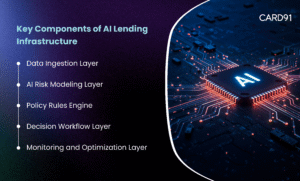
Key Components of AI Lending Infrastructure

1. Data Ingestion Layer

This layer collects borrower information from multiple sources such as:

  • credit bureaus
  • KYC systems
  • bank statements
  • transaction histories
  • alternative financial data
  • fraud detection tools

The purpose of this layer is to standardize data so it can be used effectively by risk models and decision engines.

2. AI Risk Modeling Layer

Machine learning models analyze borrower data to estimate credit risk.

These models can identify complex relationships between financial behavior, transaction patterns, and repayment probability.

The AI risk model generates risk scores that support underwriting decisions.

3. Policy Rules Engine

While AI models provide risk predictions, lenders still require policy control.

Rules engines allow financial institutions to define:

  • eligibility criteria
  • credit limits
  • pricing rules
  • regulatory compliance conditions
  • exception handling logic

This ensures automated decisions remain aligned with lending policies.

4. Decision Workflow Layer

Not all loan applications should be automatically approved or declined.

Decision workflows allow lenders to route applications based on risk signals.

Examples include:

  • automatic approvals
  • automatic declines
  • manual analyst review
  • additional document requests
  • fraud investigation workflows

Workflow orchestration ensures underwriting decisions are executed consistently.

5. Monitoring and Optimization Layer

Effective AI credit decisioning requires continuous monitoring.

Lenders must track metrics such as:

  • approval rate trends
  • portfolio default rates
  • model performance changes
  • fraud detection outcomes
  • policy effectiveness

Continuous monitoring allows lenders to refine underwriting strategies and improve portfolio quality.

Key Takeaways

  • AI credit decisioning combines machine learning, rules engines, and workflow automation.
  • Modern lenders require decision infrastructure rather than standalone scoring models.
  • AI underwriting improves decision speed and risk assessment accuracy.
  • Policy control and explainability remain essential for regulated financial institutions.
  • AI lending infrastructure enables scalable and efficient digital lending.

What Lenders Should Evaluate Before Implementing AI Decisioning

Financial institutions adopting AI credit decision platforms should evaluate several key factors.

1. Policy Governance

The platform must allow lenders to maintain full control over underwriting policies and lending criteria.

2. Model Transparency

Decision systems must provide explainable outputs so risk and compliance teams understand how decisions are generated.

3. Human Review Capabilities

Even highly automated systems must support manual reviews for complex or high-value loan applications.

4. Data Integration

The platform should integrate easily with existing systems such as:

  • loan origination systems
  • KYC platforms
  • credit bureaus
  • fraud detection tools
  • portfolio monitoring systems

5. Continuous Improvement

Decision engines should support experimentation, monitoring, and optimization of underwriting strategies over time.

Common Challenges in AI Underwriting Adoption

Despite the benefits, financial institutions often encounter several challenges when implementing AI decision systems.

1. Treating AI as Only a Scoring Upgrade

Many organizations upgrade risk models but fail to redesign their decision workflows.

2. Over-Automation

Fully automated systems without review mechanisms may introduce operational risks.

3. Lack of Explainability

If decision logic is opaque, risk teams may hesitate to rely on automated underwriting systems.

4. Weak System Integration

Decision engines that do not integrate with core lending systems create operational inefficiencies.

5. No Feedback Loop

AI underwriting systems must evolve based on real portfolio performance data.

Building a Modern Credit Decisioning Stack

A modern lending stack combines data intelligence, decision rules, and workflow automation.

By integrating AI credit decisioning infrastructure, banks and NBFCs can:

  • accelerate credit approvals
  • improve operational efficiency
  • reduce manual underwriting workloads
  • maintain regulatory compliance
  • scale lending operations effectively

Instead of treating AI as a standalone feature, lenders should view decisioning as a foundational component of the digital lending architecture.

The Role of AI in the Future of Digital Lending

AI is transforming how financial institutions evaluate credit risk.

As digital lending ecosystems expand, decision infrastructure will become increasingly important for managing lending scale and complexity.

AI credit decisioning enables financial institutions to:

  • onboard borrowers faster
  • improve credit risk assessment
  • automate underwriting workflows
  • expand access to credit for underserved segments
  • maintain real-time visibility into portfolio performance

Organizations that invest in scalable decision infrastructure today will be better positioned to compete in the evolving digital lending landscape.

Final Thoughts

AI credit decisioning is reshaping how lenders evaluate risk and scale lending operations.

However, the real advantage lies not in individual models but in the infrastructure that connects data, policy rules, workflows, and monitoring systems.

Banks and NBFCs that build this infrastructure will be able to support faster lending decisions, stronger risk management, and sustainable growth in digital lending.

Build Better Credit Decisions with AI Infrastructure

CARD91 helps banks and NBFCs build scalable credit decision systems that combine AI intelligence, policy control, and operational transparency.

Talk to CARD91

FAQ

Q: What is AI credit decisioning?
A: AI credit decisioning uses machine learning, analytics, and automated rules to evaluate borrower risk and support lending decisions such as approvals, declines, and manual reviews.

Q: How does AI improve underwriting?
A: AI analyzes larger datasets, identifies risk patterns, and automates underwriting workflows, improving both decision speed and risk assessment accuracy.

Q: Why do banks need AI lending infrastructure?
A: AI lending infrastructure helps lenders process loan applications faster, improve credit risk evaluation, and scale digital lending operations.

Q: Can AI replace human underwriters?
A: AI can automate many underwriting decisions, but human analysts remain important for complex cases, policy exceptions, and high-value loans.

Share this post

Read more

4 minutes read

In a world that has moved to the internet and the mobile, data privacy is paramount. This is more evident

3 minutes read

As India advances in its digital transformation journey, the payments landscape is rapidly evolving

Start modernising your payments with CARD91 infrastructure

To know more about our offerings connect with our experts