Subscribe to receive the latest blog posts to your inbox every week.
By subscribing you agree to with our Privacy Policy.
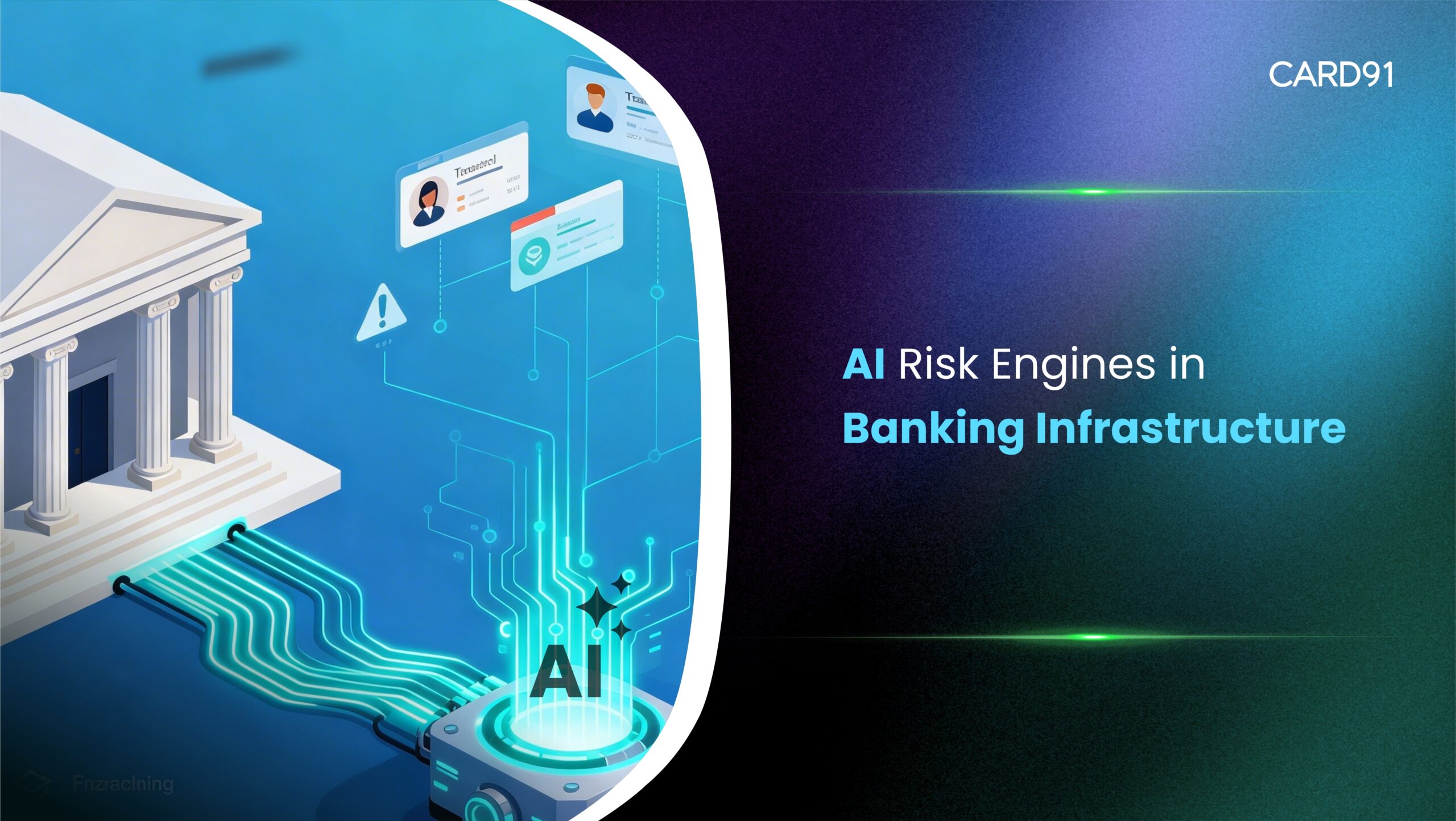
The evolution of digital payments and lending ecosystems has fundamentally altered how banks must approach risk management. With the rapid expansion of UPI transactions, embedded finance, and real-time credit products, traditional risk systems—built on static data and periodic assessment—are no longer sufficient.
Banks today require AI risk engines embedded within their infrastructure to support real-time decisioning, continuous monitoring, and policy-driven risk governance.
AI risk engines are not merely an enhancement to existing systems; they are becoming a core layer of modern banking infrastructure, enabling institutions to scale responsibly while maintaining regulatory alignment and portfolio quality.
An AI risk engine in banking is a technology framework that leverages machine learning, behavioural transaction data, and configurable policy rules to assess, monitor, and manage financial risk in real time across payment and lending workflows.
It enables banks to transition from static, point-in-time risk evaluation to continuous, intelligence-driven risk management.
With payment systems such as UPI operating in real time, risk assessment must occur within the transaction flow itself. Delayed or batch-based decisioning introduces exposure and operational inefficiencies.
Conventional underwriting models rely heavily on bureau data and historical records, which often fail to reflect current financial behaviour, especially for digitally active users.
Banks are under increasing pressure to expand lending—particularly to new-to-credit segments—while maintaining control over NPAs and portfolio performance.
Risk does not end at onboarding. Continuous monitoring, recalibration, and exposure control are essential for maintaining portfolio health in dynamic lending environments.
CARD91’s AI Lab is designed to embed risk intelligence directly into banking and payment infrastructure, rather than treating it as a standalone analytics function.
This approach ensures that risk assessment, monitoring, and decisioning are:

AI risk engines continuously evaluate customer and transaction behaviour, enabling immediate detection of anomalies and risk signals.
Every transaction is analysed in real time to identify unusual patterns, potential fraud indicators, and behavioural deviations.
Risk assessment is enhanced through behavioural data, including transaction patterns, payment consistency, and cash-flow indicators. This enables more accurate evaluation beyond traditional credit history.
Banks can define approval thresholds, risk bands, and decision rules aligned with their risk appetite, ensuring consistency and governance across workflows.
AI risk engines monitor borrower behaviour post-sanction, enabling dynamic recalibration of risk profiles and proactive exposure management.
CARD91 integrates AI risk intelligence directly into banking workflows through a structured approach:
Data Input
Transaction data, behavioural signals, and payment activity (including UPI)
AI Processing
Machine learning models analyse patterns, detect anomalies, and generate behavioural insights
Output
All processes are executed in real time, ensuring seamless integration with existing banking systems.
Implementing AI risk engines enables banks to achieve:
CARD91’s AI Lab is designed specifically for regulated financial institutions and offers:
As banking systems become increasingly real-time and data-driven, risk management must evolve accordingly.
AI risk engines enable banks to:
CARD91 AI Lab provides the infrastructure required to operationalise these capabilities effectively.
To explore how AI risk engines can be integrated into your banking infrastructure:
A: An AI risk engine is a system that uses machine learning, behavioural data, and policy rules to assess and monitor financial risk in real time across banking operations.
A: They enable real-time underwriting, behavioural scoring, and continuous monitoring, leading to improved approval accuracy and reduced default risk.
A: It refers to the use of AI models to analyse transaction behaviour in real time and detect anomalies or suspicious patterns.
A: They leverage transaction-level behavioural data to generate more accurate risk insights, particularly for new-to-credit users.
A: Banks should assess real-time processing capability, policy configurability, explainability, auditability, and integration with existing systems.
To know more about our offerings connect with our experts
Sales: sales@card91.io
HR: careers@card91.io
Media: comms@card91.io
Support: support@card91.io