Subscribe to receive the latest blog posts to your inbox every week.
By subscribing you agree to with our Privacy Policy.
Merchant onboarding does not end at document collection.
The real operational question comes after that:
Should this merchant go live now, go live with controls, or go to review?
That is where many acquiring workflows slow down.
A merchant may complete KYB, pass core checks, and still enter a review queue because the workflow cannot assign the next step clearly enough. When that happens too often, activation slows, review teams get overloaded, and low-friction merchants wait longer than they should.
Merchant review before go-live should be triggered only when the workflow cannot assign a reliable activation decision through verification, classification, and routing logic alone. In practice, review should be reserved for merchants with material inconsistency, elevated risk sensitivity, unclear classification, or control-sensitive activation needs.
That matters because not every imperfect merchant case needs manual review.
Some need clarification. Some need additional controls. Some are ready to go live. If all of them enter the same queue, review becomes a bottleneck instead of a control layer.
Merchant onboarding helps collect and verify inputs.
It does not automatically decide:
That is the gap between onboarding and action.
This is also the broader distinction behind From Merchant Onboarding to Merchant Decisioning: What Acquiring Teams Still Miss.
A stronger go-live framework starts with knowing what should not automatically go to review.
1. Minor signal weakness
One weak signal should not outweigh an otherwise clear merchant profile unless it materially changes risk or activation treatment.
2. Recoverable missing information
If a case needs clarification or another document, that may require follow-up, not full manual review.
3. Low-complexity merchants with strong alignment
If classification, KYB, and business context are broadly consistent, these merchants should not be delayed by broad review rules.
4. Routing gaps caused by weak workflow design
If the system cannot separate clear cases from exception cases, that is a design problem, not a reason to review everything.
A useful framework groups review triggers into four categories.
1. Material inconsistency
Mismatch across key business details, submitted information, or supporting documents that materially affects activation confidence.
2. Elevated risk sensitivity
Category exposure, merchant patterns, or signal combinations that materially affect fraud, compliance, or control posture. This is where How AI Is Enabling Smarter Merchant Acquiring for Banks and Fintechs becomes relevant.
3. Classification ambiguity
Cases where the workflow cannot confidently determine merchant category, MCC alignment, control design, or go-live path. That is also why AI-Driven Merchant Verification & MCC Mapping matters before activation.
4. Control-sensitive activation decisions
Merchants that may require tighter limits, enhanced monitoring, or closer scrutiny from day one.
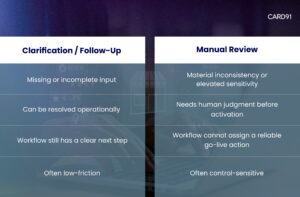
Many queues become overloaded because cases that need clarification are sent to review instead.
Stronger teams usually do five things better:
This also fits the lifecycle view in From Risk to Revenue: Mapping the Full UPI Merchant Lifecycle with CARD91.
CARD91’s acquiring stack is built around this exact shift.
Across merchant onboarding, verification, classification, MCC mapping, and lifecycle workflows, the goal is not only to onboard merchants faster, but to help banks decide more clearly before activation. That means using merchant signals to support better routing, better control design, and better go-live decisions.
That is why reducing merchant review before go-live is not about lowering scrutiny.
It is about applying scrutiny more precisely.
Merchant review is not the problem.
Poor review design is.
The goal is not to send fewer merchants into control.
The goal is to make sure only the right merchants reach merchant review before go-live: Book a demo with CARD91
Q: What should trigger merchant review before go-live?
A: Merchant review before go-live should be triggered when the workflow cannot assign a reliable activation decision because of material inconsistency, elevated risk sensitivity, classification ambiguity, or control-sensitive activation needs.
Q: Should incomplete merchant information always trigger review?
A: No. If the issue can be resolved through clarification or follow-up, it may not require full manual review.
Q: What is the difference between merchant clarification and merchant review?
A: Clarification is used when missing or incomplete inputs can be resolved operationally. Review is used when human judgment is needed before activation.
Q: Why do merchant review queues become bottlenecks?
A: They become bottlenecks when too many low-friction or poorly segmented merchant cases are sent to manual review by default.
Q: How can banks reduce merchant review delays before go-live?
A: Banks can reduce delays by connecting onboarding outputs to go-live decisions, improving classification, making review selective, and aligning controls to merchant context.


To know more about our offerings connect with our experts