Home / Blogs 

Routing Breakdowns in Digital Onboarding: How Banks and NBFCs Can Identify Them Early

Routing breakdowns in digital onboarding for banks and NBFCs

4 minutes read

Routing breakdowns in digital onboarding often show up before teams realise there is a larger workflow problem.

At first, the signals may look small. A few good cases wait longer than expected. More cases move into review than usual. Clarification cases start mixing with sensitive review cases. Similar profiles receive different outcomes across queues.

Over time, these small signals turn into larger issues: overloaded review teams, slower onboarding, inconsistent decisions, and weaker operational control.

For banks and NBFCs, the goal is not only to fix routing after it breaks. The goal is to identify routing breakdowns early.

What are routing breakdowns in digital onboarding?

Routing breakdowns in digital onboarding happen when cases do not move into the right workflow path at the right time.

In practice, that means:

  • decision-ready cases get delayed
  • clarification cases move into review
  • sensitive cases do not receive enough attention
  • similar cases get routed differently
  • review queues become broader than they should be

That matters because a strong onboarding workflow should know what each case needs next: approval, review, rejection, or clarification.

This is also why Digital Onboarding Workflow Gaps: How Banks and NBFCs Can Improve Routing and Decision Quality and BFSI Onboarding Workflow Design: How Teams Should Structure Approve, Review, and Reject Decisions connect closely with this topic.

Why routing breakdowns are hard to spot

Routing issues rarely appear as one obvious failure.

They usually appear as patterns.

A review queue may slowly grow. A clarification path may start carrying the wrong cases. Similar cases may be handled differently by different teams. These patterns can look like normal operational variation until they begin affecting decision quality.

That is why stronger BFSI teams look for early warning signals instead of waiting for backlog pressure.

Early signs of routing breakdowns in digital onboarding

1. Review load rises without a clear risk shift

If more cases are entering review but the risk profile has not changed, the issue may be routing quality.

This connects directly to What Should Trigger Manual Review in BFSI Onboarding? A Practical Decision Framework.

2. Clarification cases enter review too often

Cases that only need more information should not compete with decision-sensitive cases.

This is why What Good Clarification Workflow Design Looks Like in Digital Onboarding matters operationally.

3. Similar cases receive different outcomes

If similar cases are approved, reviewed, or delayed differently, the workflow may lack consistency.

This links directly to Decision Consistency in BFSI Onboarding: How Teams Can Improve Outcomes Across Queues.

4. Queue priority stops matching case impact

When low-impact cases receive attention before sensitive ones, triage quality weakens.

That is where Queue Priority in BFSI Onboarding: How Ops Teams Should Triage Cases becomes important.

5. Review backlogs grow despite faster processing

If teams process more cases but backlog still grows, the wrong cases may be entering review upstream.

This is also why How Banks and NBFCs Can Reduce Review Backlogs Without Weakening Control is a useful companion read.

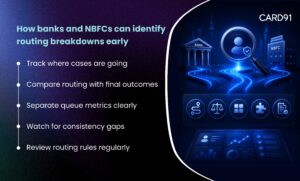
How banks and NBFCs can identify routing breakdowns early

1. Track where cases are going

Teams should monitor how many cases enter approval, review, rejection, and clarification paths.

2. Compare routing with final outcomes

If many reviewed cases eventually get approved with little intervention, the workflow may be over-routing to review.

3. Separate queue metrics clearly

Review, clarification, approval, and rejection should not be measured as one blended workflow.

4. Watch for consistency gaps

Similar cases should not produce very different decisions across queues or teams.

5. Review routing rules regularly

Routing logic should evolve as case patterns, risk appetite, and operational priorities change.

This is also why BFSI Onboarding Operations Metrics: What Good Ops Teams Track After Onboarding fits naturally with routing breakdown detection.

Where CARD91 fits

CARD91’s VerifyIQ fits naturally into this problem because early routing breakdown detection depends on better signal interpretation, confidence-led triage, and cleaner workflow movement.

If teams can understand which cases are moving into the wrong paths, they can improve routing before review queues become overloaded.

That makes routing visibility an important part of stronger onboarding operations.

Key takeaways

  • Routing breakdowns in digital onboarding often appear as small workflow patterns before they become large operational problems.
  • Rising review load, inconsistent outcomes, and poor clarification handling are early warning signs.
  • Stronger teams track where cases go, why they go there, and what happens after.
  • Better routing visibility improves speed, control, and decision consistency.
  • Early detection helps banks and NBFCs fix workflow issues before they become backlog problems.

Final thought

Routing problems do not become visible only when queues are full.

They start earlier, in the way cases move through the workflow.

That is why good BFSI teams identify routing breakdowns before they turn into review pressure.

Book a VerifyIQ demo

FAQs

Q: What are routing breakdowns in digital onboarding?

A: Routing breakdowns happen when onboarding cases do not move into the right workflow path at the right time.

Q: Why should banks identify routing breakdowns early?

A: Because early detection helps prevent review overload, decision inconsistency, and onboarding delays.

Q: What are early signs of routing breakdowns?

A: Rising review load, clarification cases entering review, inconsistent outcomes, and poor queue priority are common signs.

Q: How can banks reduce routing breakdowns?

A: Banks can reduce them by tracking case movement, reviewing routing rules, separating queue metrics, and improving decision consistency.

Q: How does VerifyIQ help?

A: VerifyIQ helps improve signal interpretation and routing visibility so teams can identify and reduce routing breakdowns earlier.

Share this post

Read more

4 minutes read

In a world that has moved to the internet and the mobile, data privacy is paramount. This is more evident

3 minutes read

As India advances in its digital transformation journey, the payments landscape is rapidly evolving

Start modernising your payments with CARD91 infrastructure

To know more about our offerings connect with our experts