Subscribe to receive the latest blog posts to your inbox every week.
By subscribing you agree to with our Privacy Policy.
A customer completes onboarding. Identity checks are done. Documents are validated. Verification signals are available.
And yet, the application still does not move forward.
It gets routed for review, pushed into an operations queue, or delayed until someone manually examines it. Not because the checks failed. Not because the case is clearly risky. But because verification alone has not made the case decision-ready.
That is the gap many BFSI teams still face.
Post-verification decisioning in BFSI onboarding is the layer that determines what should happen after verification is complete. It helps banks, NBFCs, and insurers decide whether a case should be approved, reviewed, rejected, or re-verified based on the overall strength, consistency, and usability of the available signals.
This matters because verification alone does not always answer the most important operational question:
What should happen next?
For many institutions, the challenge today is no longer whether checks can be run. Most onboarding systems already validate identity, documents, business details, and other supporting inputs in some form. The real issue is whether those completed checks lead to a clear and timely action.
That is where BFSI onboarding decisioning becomes critical.
Verification and decisioning are related, but they are not the same thing.
Verification helps confirm whether submitted information appears valid. Decisioning determines what action should follow based on the overall strength and meaning of those signals.
In simple terms:
This distinction is at the heart of modern onboarding design.
A system can verify a PAN, validate a registration, check a mobile number, or assess document consistency. But if those signals remain fragmented, the workflow still depends on human interpretation to decide what happens next.
That is why many onboarding journeys look digitised on paper but still slow down in practice.
Read more: Verification vs Risk Scoring vs Decisioning in BFSI: Key Differences Explained
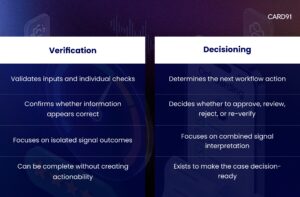
This is why a case can be verified and still not move forward.
In many BFSI workflows, verification is treated as the finish line. Once signals are collected, the system assumes the hard part is done.
But that is often where the real operational complexity begins.
Once checks are complete, teams still need answers to questions like:
If the system cannot answer these questions clearly, manual intervention becomes the default.
That is where delays begin to compound. Review queues grow, low-risk cases move more slowly than they should, and digital onboarding loses speed even when verification coverage is already in place.
Read more: Why BFSI Onboarding Still Depends on Manual Reviews — And What Needs to Change
A case can pass verification and still remain unclear.
That happens because verification confirms inputs, but decisioning after verification depends on how those inputs come together.
A customer may have valid documents, matching identity details, and no obvious red flags. But if the signals are incomplete, weakly weighted, inconsistent across sources, or disconnected from workflow logic, the system may still not know how confidently it should act.
That is the missing layer.
Many onboarding systems validate data, but they do not convert that data into a clear operational next step.
As a result, even verified cases are often pushed into review queues simply because the system lacks a structured post-verification decisioning layer.
This is the broader shift behind verification intelligence in onboarding.
Consider two onboarding cases.
Case A
The customer’s information is consistent across checks. Identity details align. Document quality is acceptable. Supporting signals are complete. No meaningful contradiction appears in the verification flow.
Case B
The customer passes core identity checks too. But supporting signals are limited. A few fields are incomplete. Some low-severity mismatches appear. Nothing is severe enough for rejection, but the case is still not strong enough for immediate approval.
In both cases, verification is complete.
But both cases are not equally decision-ready.
If the system treats them the same way, both may end up in manual review. That increases workload, delays onboarding, and reduces the value of having digital verification in the first place.
What is needed instead is a way to interpret verification outcomes in context and convert them into a clear next step.
That is what post-verification decisioning is meant to do.
A post-verification decisioning layer sits between completed verification and workflow action.
Its role is not to replace verification. Its role is to make verification actionable.
A strong decisioning layer helps institutions:
In simple terms, it answers:
Given everything the system now knows, what should happen next?
That is the question many onboarding systems still fail to answer consistently.
This is the problem CARD91 is solving through VerifyIQ.
Instead of stopping at isolated checks, VerifyIQ is built to help institutions bring fragmented verification signals into one decision-ready flow. The goal is not just to verify more inputs, but to make onboarding decisions clearer, faster, and more structured.
For banks, NBFCs, and insurers, this matters because operational speed is not created by checks alone. It is created when checks can be interpreted, prioritised, and routed into the right next action.
Manual reviews do not always happen because a case is high risk.
Often, they happen because the system lacks enough certainty to act confidently.
That distinction matters.
A case may not look risky enough to reject, but it may also not feel strong enough for straight-through approval if the system cannot interpret the overall signal quality clearly. In those situations, it gets sent to human reviewers.
Over time, that creates three problems.
1. Good cases move too slowly
Low-risk applicants or merchants are delayed because systems cannot clearly identify which verified cases are ready to move forward.
2. Operations teams carry avoidable workload
Review teams spend time on borderline or low-friction cases that should have been triaged more intelligently upstream.
3. Automation remains incomplete
Institutions may invest in verification infrastructure but still fail to achieve decision-speed outcomes because the action layer is weak.
This is why reduce manual review in BFSI onboarding is not just an ops problem. It is also a workflow design problem.
Modern onboarding systems need more than a stack of checks. They need a way to turn those checks into confident workflow decisions.
That usually requires four capabilities.
1. Signal unification
Identity checks, document validation, business attributes, fraud-related inputs, and alternate signals cannot sit in silos. They need to be interpreted together.
2. Contextual weighting
Not every signal should matter equally. Decisioning should reflect product type, institution policy, use case, and risk appetite.
3. Confidence-led routing
Cases should not move only on pass/fail logic. They should move based on how strong, complete, and decision-ready the overall case appears.
4. Clear workflow outcomes
The system should be able to route cases into approve, review, reject, or re-verify outcomes instead of relying on manual review by default.
This is how onboarding moves from “checks completed” to “decision made.”
A confidence score helps bridge the gap between verification and decisioning.
Instead of only asking whether a case looks risky, confidence scoring asks whether the available signals are strong enough to act on. That makes it especially useful in workflows where verification is complete but the next action is still unclear.
In that sense, confidence scoring is not just another score. It is a way to turn fragmented verification outcomes into clearer routing decisions.
Read more: What Is a Confidence Score in BFSI Onboarding? Why It Matters More Than Risk Scores
The strongest onboarding systems are moving away from isolated verification steps and toward decision-ready workflows.
That means they are no longer asking only:
They are also asking:
That shift improves how onboarding performs at scale.
It helps institutions reduce unnecessary review dependency, improve triage quality, and maintain control without slowing growth. The same principle is visible in adjacent workflows such as real-time risk assessment in digital lending and AI merchant verification.
As onboarding journeys expand across lending, cards, merchant identification, insurance, and account opening, the cost of delay becomes more visible.
The issue is not that institutions lack verification infrastructure.
The issue is that many workflows still stop before verification becomes actionable.
That is why the next phase of onboarding design is not about simply adding more checks.
It is about building the layer that decides what should happen after those checks are done.
Verification tells you whether information appears valid.
Decisioning tells you what to do with that information.
And in many BFSI workflows, that second step is still the missing layer.
Q: What is post-verification decisioning in BFSI onboarding?
A: Post-verification decisioning in BFSI onboarding is the layer that determines what should happen after checks are complete. It helps institutions decide whether a case should be approved, reviewed, rejected, or re-verified.
Q: Why do verified cases still go into manual review?
A: Verified cases still go into manual review when systems cannot interpret the overall strength, consistency, or completeness of the available signals clearly enough to assign a confident next step.
Q: What is the difference between verification and decisioning?
A: Verification checks whether information appears valid. Decisioning determines what workflow action should happen next based on the combined meaning of those signals.
Q: How does confidence scoring help after verification?
A: Confidence scoring helps institutions understand whether the available signals are strong enough to act on. This improves routing, reduces unnecessary reviews, and supports faster onboarding.
Q: Why is post-verification decisioning important for banks, NBFCs, and insurers?
A: Because these institutions need onboarding flows that are fast, controlled, scalable, and policy-aligned. Without a decisioning layer, verification alone often leads to delays and operational inefficiency.


To know more about our offerings connect with our experts