Subscribe to receive the latest blog posts to your inbox every week.
By subscribing you agree to with our Privacy Policy.
A customer completes onboarding in minutes. Their details are verified, a risk score is generated, and everything appears to be in order. Yet the application does not move forward. Instead, it gets flagged, routed for manual review, and delayed. Not because something is necessarily wrong, but because the system does not know what action should come next.
This is where many BFSI onboarding journeys begin to break down. The issue is rarely a lack of checks. More often, the real problem is that verification, risk scoring, and decisioning are treated as if they are interchangeable, even though each plays a distinct role in the onboarding process. When these layers are not clearly separated and connected, workflows slow down, manual intervention increases, and operational efficiency suffers.
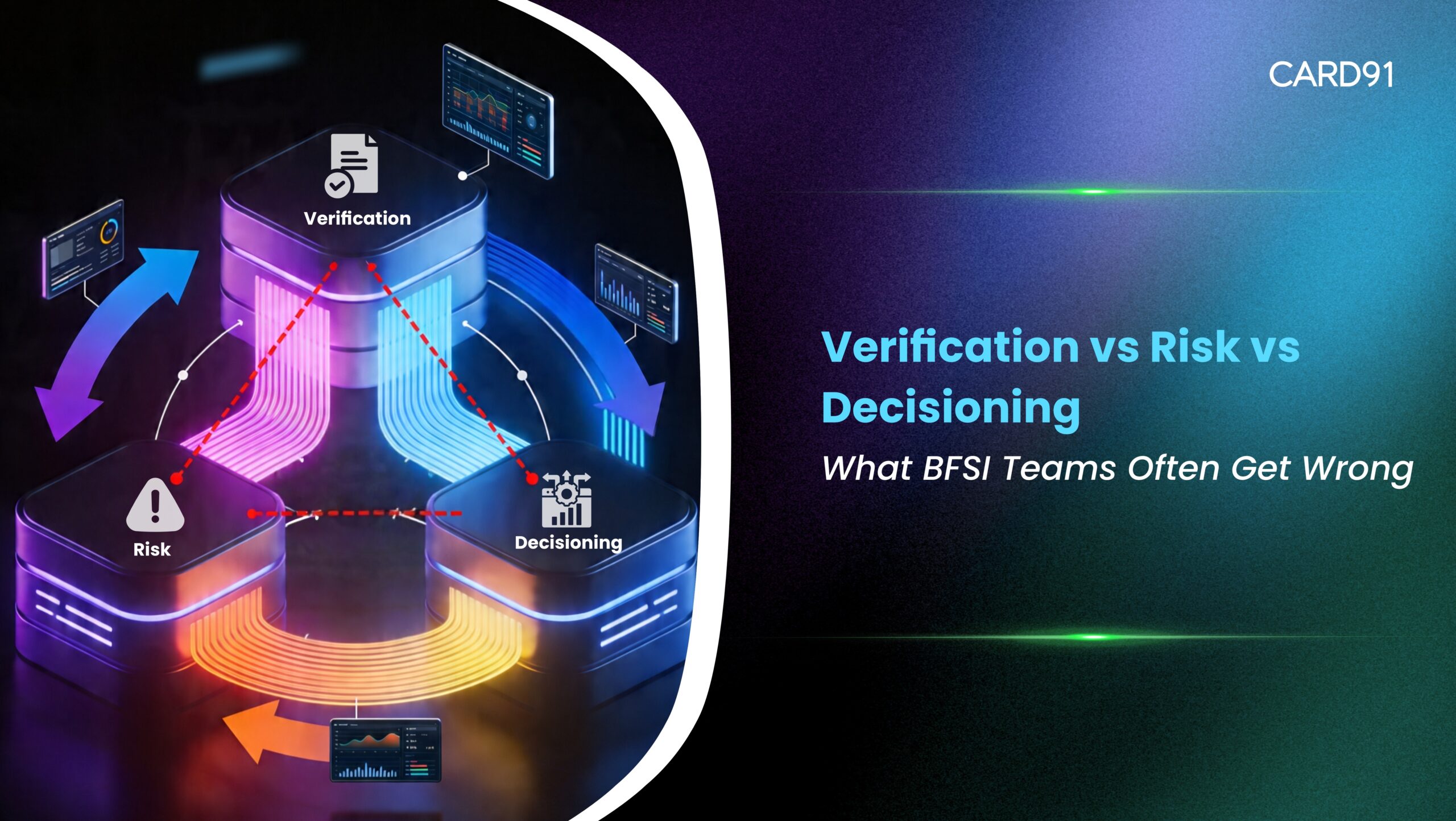
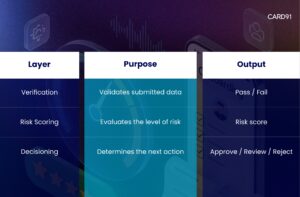
At a high level, verification is about confirming whether submitted information is valid. Risk scoring is about evaluating how risky that information may be. Decisioning is about determining what action should be taken based on those inputs.
In simple terms, verification validates, risk scoring interprets, and decisioning acts.
This distinction may sound straightforward, but it is one of the most important foundations of an efficient onboarding system. When these layers work together in a structured and connected way, onboarding becomes faster, more consistent, and easier to scale. When they are blurred, cases often get stuck between checks, scores, and decisions, creating unnecessary friction.
For a broader perspective on how onboarding is moving beyond isolated checks, you can also read Verification Intelligence in Onboarding.
Verification in BFSI onboarding is the process of confirming whether the information submitted by a customer is accurate, authentic, and trustworthy. This usually includes identity verification, document validation, database checks, and consistency checks across multiple data points.
It is a foundational layer because every downstream process depends on the quality of the input being assessed. If the source information is unreliable, the rest of the onboarding workflow becomes unstable.
However, verification alone does not decide the outcome of an application. A case may pass verification successfully and still require review, escalation, or even rejection depending on the broader context. Verification tells the system that the information is valid, but it does not determine what should happen next.
Risk scoring in banking onboarding is the process of evaluating the level of risk associated with a customer or transaction using available signals, patterns, and data inputs. It helps institutions understand how much caution may be required before moving ahead.
This layer brings intelligence into the workflow. It helps analyse patterns, assign a score, and estimate the likelihood of risk. But even then, a risk score is not a decision.
A low-risk score does not automatically mean approval, and a high-risk score does not always mean rejection. Risk scoring provides interpretation and context, not the final operational outcome. It helps teams understand what the inputs may mean from a risk perspective, but it still does not define the next step.
To understand how real-time risk systems support this layer, read AI Risk Engines in Banking Infrastructure.
Decisioning in BFSI is the process of turning verification outcomes and risk signals into a final action such as approve, review, or reject through predefined rules, policies, thresholds, and workflows.
This is the layer that makes onboarding operational. Without decisioning, a system may be able to validate data and generate a risk score, but it still cannot move the application forward with clarity or consistency.
Decisioning is what connects intelligence to action. It ensures that the organisation is not just collecting signals and assessing risk, but also applying that understanding in a structured and repeatable way. In practical terms, it is the difference between a system that can evaluate and a system that can actually operate.
For a deeper understanding, explore AI Financial Decision Engines in Banking.
For a lending-specific perspective, read AI Credit Decisioning Infrastructure.
One of the most common reasons onboarding slows down is that verification, scoring, and decisioning are not treated as separate layers. In many systems, verification is assumed to be the decision. In others, risk scores are treated as final outcomes instead of being used as inputs into a broader decision workflow.
When this happens, manual review becomes the default gap-filler. Teams are forced to step in because the system can validate and score, but it cannot confidently determine what should happen next.
The result is familiar across many BFSI onboarding operations: delays, inconsistent handling, growing review queues, and increased dependence on manual effort. A system may collect data, verify inputs, and assign a score, but if it cannot translate those signals into a clear next action, the process remains incomplete.
If you want to understand how this affects real workflows, read Why BFSI Onboarding Still Depends on Manual Reviews.
A useful way to understand this difference is to think about airport security. Verification is the process of checking a passenger’s identity. Risk scoring is the assessment of behavioural or travel-related indicators that may suggest higher scrutiny. Decisioning is the final operational action, whether that means allowing the passenger to proceed, sending them for additional screening, or stopping them altogether.
These layers are closely connected, but they are not the same.
BFSI onboarding works in much the same way. Completing verification does not mean the decision is complete. Generating a score does not automatically define the right action. The onboarding journey only becomes truly effective when these stages are connected in a way that enables clear and timely outcomes.
Most BFSI onboarding systems already have some form of verification and risk scoring in place. They can validate information, assess risk, and surface relevant signals. Yet many still lack a strong decisioning layer that can convert those insights into a consistent operational outcome.
That gap is where friction begins.
Even when data is correct and risk scoring is accurate, onboarding still slows down if the system cannot confidently determine the next step. This is why so many workflows continue to fall back on manual review. It is not always because the organisation lacks data or intelligence. Often, it is because the process lacks the logic needed to act on that intelligence at the right time.
Modern onboarding systems are increasingly being designed to move beyond standalone validation. Instead of treating verification and scoring as disconnected functions, they connect these layers through decision-ready workflows and rule-based logic.
This allows institutions to unify fragmented signals, automate routing, reduce unnecessary manual intervention, and produce clearer outcomes at scale. The goal is no longer just to run more checks. The goal is to create systems that can move confidently from input validation to risk understanding to action.
That shift is what makes onboarding more scalable, more reliable, and more operationally efficient.
At CARD91, this is the exact gap we see across BFSI onboarding systems. The challenge is not simply collecting more signals. The real challenge is connecting those signals in a way that supports faster and more confident onboarding decisions.
Solutions like VerifyIQ are built to address that need by bringing together verification signals, risk indicators, and decisioning logic within a unified workflow. This helps teams move beyond a basic pass-or-fail view of onboarding and instead focus on a more meaningful question: do we have enough confidence to proceed?
That shift changes onboarding from being validation-driven to becoming decision-driven.
To improve onboarding efficiency, BFSI teams need to stop treating verification, scoring, and decisioning as interchangeable steps. The focus should instead be on clearly separating these layers, connecting fragmented signals, implementing structured decision workflows, automating rule-based routing, and reducing unnecessary manual intervention.
This approach does not just make onboarding faster. It also makes the process more consistent, scalable, and easier to manage across growing volumes and more complex risk scenarios.
Verification confirms that the input can be trusted. Risk scoring helps interpret what that input may mean. Decisioning determines what should happen next.
Each layer matters on its own, but the real value comes from how they work together.
The BFSI teams that understand this distinction clearly will be better positioned to build onboarding systems that are faster, more scalable, and far more effective in practice.
Explore how CARD91 helps BFSI teams connect verification, scoring, and decisioning into a unified onboarding workflow with VerifyIQ.
Q: What is the difference between verification, risk scoring, and decisioning?
A: Verification validates whether the input data is correct. Risk scoring evaluates how risky that data may be. Decisioning determines what action should be taken based on those inputs. Each layer serves a different purpose in onboarding.
Q: Why is it important to separate verification, risk scoring, and decisioning?
A: Separating these layers ensures clarity in the onboarding process. When they are combined or confused, systems struggle to determine the next step, which leads to delays and increased manual reviews.
Q: Can verification alone complete onboarding?
A: No. Verification only confirms that the data is valid. It does not determine whether the application should be approved, reviewed, or rejected. That requires risk scoring and decisioning.
Q: Is a risk score the same as a decision?
A: No. A risk score is an indicator of risk, not a final outcome. A low risk score does not always mean approval, and a high risk score does not always mean rejection. Decisioning is required to convert scores into actions.
Q: What happens if decisioning is missing in onboarding systems?
A: If decisioning is missing, systems can validate data and generate risk scores but cannot take action. This results in cases being sent for manual review, slowing down onboarding workflows.
Q: How does decisioning improve onboarding efficiency?
A: Decisioning improves efficiency by applying rules and thresholds to automatically determine outcomes. This reduces ambiguity, speeds up processing, and ensures consistency across cases.
Q: How are verification, risk scoring, and decisioning connected?
A: Verification provides reliable inputs, risk scoring interprets those inputs, and decisioning uses both to determine the next action. Together, they form a complete onboarding workflow.
Q: Why do many BFSI systems struggle with these layers?
A: Many systems struggle because these functions are built in isolation. Without integration, signals remain fragmented, and workflows depend heavily on manual intervention.


To know more about our offerings connect with our experts