Home / Blogs 

AI Payment Infrastructure for Real-Time Payments: What Banks Need to Know

AI Payment Infrastructure for Real-Time Payments

5 minutes read

AI Payment Infrastructure

As payment volumes grow and customer expectations rise, banks and fintechs need infrastructure that can process transactions instantly while managing risk in real time. AI payment infrastructure enables intelligent decision-making, fraud detection, and scalable payment operations across modern financial ecosystems.

What are AI Payment Processing Systems?

AI payment processing systems are core transaction engines that use machine learning, behavioral analysis, and configurable rules to authorize, monitor, and manage payments in real time.

Why AI Payment Infrastructure Matters for Banks

AI infrastructure enables banks to:

  • Process transactions in real time
  • Detect fraud at the transaction level
  • Scale payment systems without operational bottlenecks
  • Maintain regulatory and audit readiness

Introduction: Real-Time Payments Demand Infrastructure-Led Intelligence

Real-time payment systems operate with near-zero tolerance for latency, inconsistency, or weak controls.

Transactions are:

  • Authorized in seconds
  • Risk signals emerge in milliseconds
  • Decisions have immediate financial impact

For banks, this changes the equation:

Payment infrastructure is no longer a backend system — it is a core risk and performance layer.

Legacy systems built for batch processing cannot meet these demands.
This is where AI payment infrastructure becomes essential.

What AI Payment Infrastructure Actually Means

AI payment infrastructure is not an add-on analytics tool.

It is:

Intelligence embedded within the payment processing layer — where decisions are made, not after they are made.
Core Characteristics

  • Operates within transaction flow
  • Continuously evaluates risk signals
  • Produces real-time, policy-aligned decisions
  • Maintains traceability and auditability

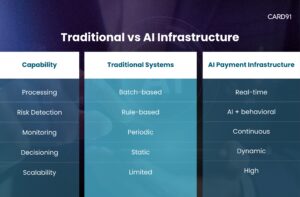
Traditional vs AI Infrastructure

Traditional vs AI Infrastructure

Why Traditional Payment Stacks Fail in Real-Time Systems

Most banking infrastructure was designed for:

  • Lower transaction volumes
  • Predictable payment flows
  • Periodic risk review

Key Limitations

  • Static rule engines cannot adapt to dynamic fraud
  • Risk is assessed at intervals, not continuously
  • Siloed systems delay decision-making
  • Integration complexity slows innovation


Result:

A gap between transaction speed and risk intelligence

How AI Payment Infrastructure Powers Real-Time Payments

1. Data Ingestion Layer

Captures:

  • Transaction data
  • Behavioral signals
  • Device and usage patterns

2. AI Decision Engines

  • Risk scoring
  • Fraud detection
  • Real-time authorization logic

3. Processing Layer

  • Low-latency transaction execution
  • Instant routing and approval

4. Continuous Monitoring

  • Real-time alerts
  • Behavioral tracking
  • Dynamic risk updates

This ensures intelligence operates inside the transaction flow

Role of AI Payment Processing Systems

AI payment processing systems operate at the core transaction layer.

They enable:

Transaction Monitoring

Detect anomalies and unusual patterns in real time

Merchant Risk Assessment

Improve onboarding accuracy and post-activation monitoring

Credit & Exposure Management

Support real-time credit decisions (e.g., UPI credit flows)

Operational Visibility

Provide real-time dashboards and insights

Core Capabilities Banks Should Expect

1. Real-Time Risk Monitoring

Continuous evaluation of transactions without latency

2. Early Fraud Detection

Lifecycle-based fraud prevention (onboarding → transactions → usage)

3. Behavioral Intelligence

Risk assessment based on real usage patterns

4. Configurable Policy Frameworks

Banks retain control over:

  • Risk thresholds
  • Decision rules
  • Compliance logic

Benefits for Banks

Faster Transaction Processing

Improve customer experience and reduce friction

Reduced Fraud Exposure

Detect risk before losses occur

Operational Efficiency

Reduce dependency on manual review

Scalable Infrastructure

Handle increasing transaction volumes seamlessly

Infrastructure-Led AI vs Bolt-On AI Tools

Bolt-On AI

  • Operates after transactions
  • Improves reporting
  • Cannot influence real-time decisions

Infrastructure-Led AI

  • Embedded in transaction flow
  • Influences authorization decisions
  • Enables real-time risk control


For banks, this difference is
operationally critical

CARD91: Building AI-Native Payment Infrastructure

Modern payment systems must be:

  • Real-time
  • Scalable
  • Policy-driven
  • Compliance-aligned

CARD91 enables this through:


Key Capabilities

  • Real-time transaction processing
  • Merchant verification and classification
  • Credit Line on UPI infrastructure
  • Behavioral risk monitoring
  • Policy-driven decision engines


The focus is not just processing—but
intelligent payment orchestration

FAQs

Q: What is AI payment infrastructure?

A: AI payment infrastructure combines machine learning, automation, and real-time data processing to improve payment processing, fraud detection, and risk management.

Q: Why is AI important for real-time payments?

A: AI helps detect fraud, monitor risk, optimize transaction routing, and improve operational efficiency without slowing down payment processing.

Q: How do banks use AI in payment infrastructure?

A: Banks use AI for transaction monitoring, fraud prevention, anomaly detection, customer risk assessment, and payment operations automation.

Q: Can AI reduce payment fraud?

A: Yes. AI can identify suspicious patterns and anomalies in real time, helping financial institutions prevent fraud before losses occur.

Q: What are the benefits of AI payment infrastructure?

Key benefits include faster payments, better fraud prevention, improved scalability, lower operational costs, and stronger risk management.

Evaluating your payment infrastructure?

Talk to our team about AI-native, bank-grade infrastructure

Share this post

Read more

4 minutes read

In a world that has moved to the internet and the mobile, data privacy is paramount. This is more evident

3 minutes read

As India advances in its digital transformation journey, the payments landscape is rapidly evolving

Start modernising your payments with CARD91 infrastructure

To know more about our offerings connect with our experts