Subscribe to receive the latest blog posts to your inbox every week.
By subscribing you agree to with our Privacy Policy.
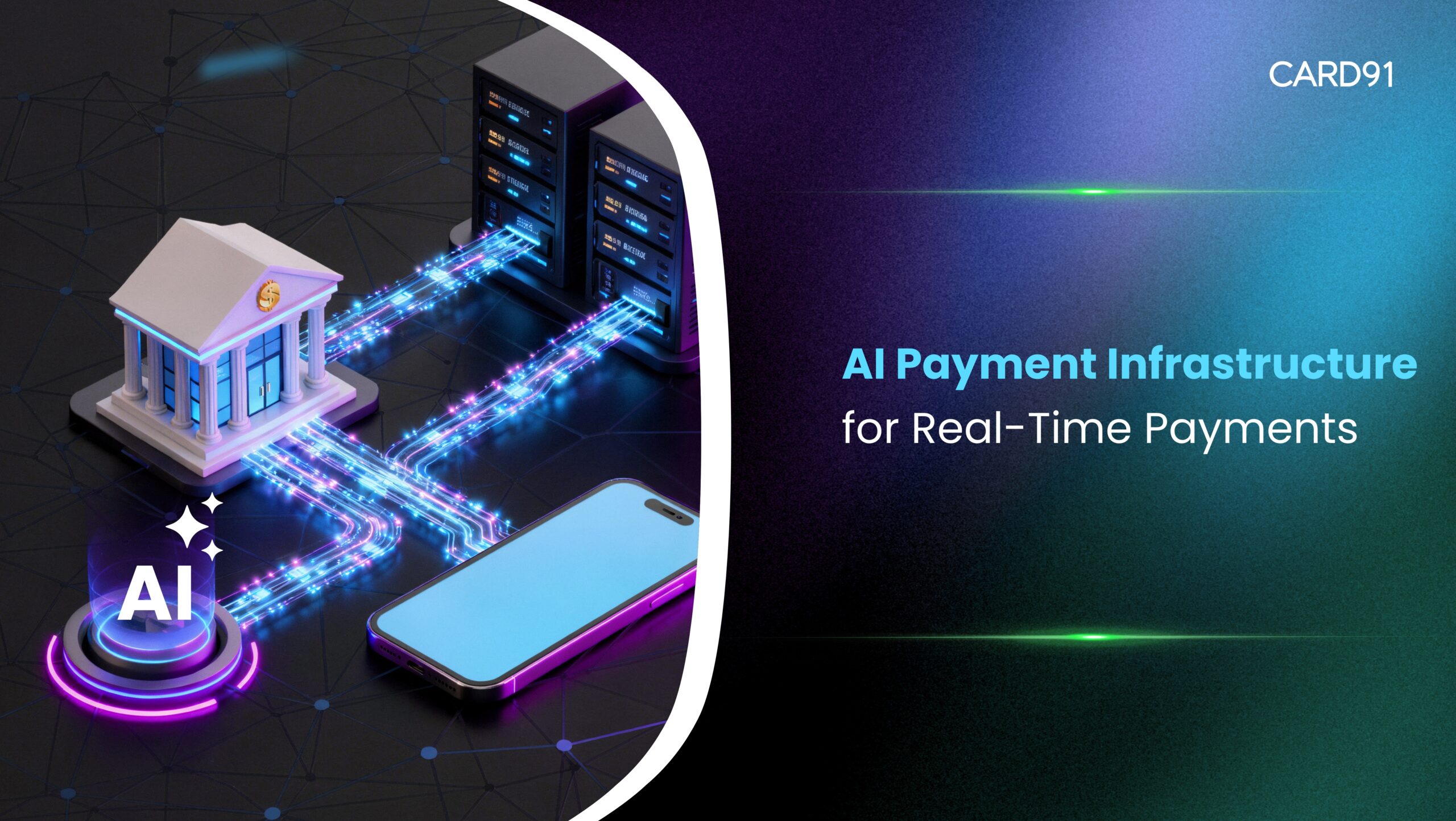
AI payment infrastructure is intelligence embedded directly into payment processing systems that enables real-time transaction decisioning, continuous risk monitoring, and policy-driven execution for banks and regulated financial institutions.
AI payment processing systems are core transaction engines that use machine learning, behavioral analysis, and configurable rules to authorize, monitor, and manage payments in real time.
AI infrastructure enables banks to:
Real-time payment systems operate with near-zero tolerance for latency, inconsistency, or weak controls.
Transactions are:
For banks, this changes the equation:
Payment infrastructure is no longer a backend system — it is a core risk and performance layer.
Legacy systems built for batch processing cannot meet these demands.
This is where AI payment infrastructure becomes essential.
AI payment infrastructure is not an add-on analytics tool.
It is:
Intelligence embedded within the payment processing layer — where decisions are made, not after they are made.

Most banking infrastructure was designed for:
Result:
A gap between transaction speed and risk intelligence
Captures:
This ensures intelligence operates inside the transaction flow
AI payment processing systems operate at the core transaction layer.
They enable:
Detect anomalies and unusual patterns in real time
Improve onboarding accuracy and post-activation monitoring
Support real-time credit decisions (e.g., UPI credit flows)
Provide real-time dashboards and insights
Continuous evaluation of transactions without latency
Lifecycle-based fraud prevention (onboarding → transactions → usage)
Risk assessment based on real usage patterns
Banks retain control over:
Improve customer experience and reduce friction
Detect risk before losses occur
Reduce dependency on manual review
Handle increasing transaction volumes seamlessly
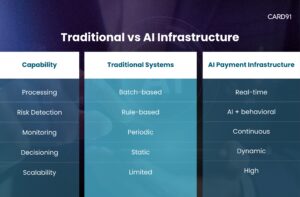
For banks, this difference is operationally critical
Modern payment systems must be:
CARD91 enables this through:
The focus is not just processing—but intelligent payment orchestration
A: AI payment infrastructure is intelligence embedded into payment systems that enables real-time processing, risk monitoring, and decision-making.
Q: How does AI improve payment processing?
A: AI enables real-time decisioning, fraud detection, and behavioral analysis within transaction flows.
Q: Why do banks need AI payment infrastructure?
A: Banks need AI to handle real-time payments, reduce fraud risk, and scale operations efficiently.
Q: What are AI payment processing systems?
A: They are transaction engines that use AI to authorize, monitor, and manage payments in real time.
Q: Is AI payment infrastructure compliant?
A: Yes, when built with policy controls and auditability, it aligns with regulatory frameworks.
Evaluating your payment infrastructure?
Talk to our team about AI-native, bank-grade infrastructure
To know more about our offerings connect with our experts
Sales: sales@card91.io
HR: careers@card91.io
Media: comms@card91.io
Support: support@card91.io