Subscribe to receive the latest blog posts to your inbox every week.
By subscribing you agree to with our Privacy Policy.
Banks launching CLOU must ensure credit line on UPI compliance with RBI digital lending guidelines.
Credit Line on UPI (CLOU) is not just a payments innovation—it is a regulated digital lending product operating on real-time rails.
While UPI enables speed and reach, regulatory accountability remains with the issuer bank. Every CLOU transaction, repayment, and collection action is subject to scrutiny under:
Banks that treat compliance as a post-launch activity often face operational friction, audit observations, and regulator queries. CLOU success depends on compliance-by-design, not compliance-by-exception.
These compliance requirements are embedded into how banks implement Credit Line on UPI in practice, rather than applied after go-live.
This article explains how banks operationalise CLOU in line with Digital Lending Guidelines and remain regulator-ready at scale.
Although CLOU uses UPI as the payment rail, it represents credit extended by the bank and therefore qualifies as digital lending.
Key characteristics that trigger DLG applicability:
As a result, CLOU must adhere to end-to-end digital lending compliance, not just payments compliance.
A compliant CLOU framework rests on five foundational pillars.
Digital Lending Guidelines require explicit, informed consent before credit activation.
Banks must ensure:
In CLOU, consent is typically captured before UPI PIN setup, making it a gating control rather than a formality.
DLG mandates that:
CLOU complies with this by:
This design ensures clear audit trails and fund traceability.
Banks must provide customers with:
In CLOU, these disclosures must be:
Failure to maintain accurate, timely communication is a common source of customer complaints and regulatory escalation.
Digital Lending Guidelines place strict expectations on collections conduct.
For CLOU, this means:
Because CLOU operates in real time, banks can:
In practice, many of these safeguards are enforced through real-time risk controls in Credit Line on UPI, ensuring compliance is proactive rather than reactive.
This proactive approach aligns strongly with fair-practice expectations.
Compliance does not end at customer interaction—it extends to continuous reporting.
Banks must maintain:
Compliance also requires full visibility across the complete Credit Line on UPI lifecycle, from pre-sanction to collections and closure.
In CLOU, reporting must be continuous and automated, as manual reconciliation does not scale under UPI transaction volumes.
Banks that underestimate compliance requirements often encounter:
These issues are rarely product-level—they are architecture and process failures.
To stay regulator-ready, CLOU platforms should embed:
When compliance is built into the system, governance scales automatically with volume.
CARD91 enables banks to run Digital Lending Guidelines-compliant Credit Line on UPI programs through its unified CLOU infrastructure.
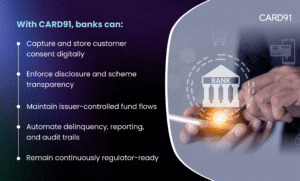
This infrastructure-led approach ensures compliance is systemic, not procedural.
In Credit Line on UPI, compliance is not a checkbox at launch—it is a continuous operating condition.
Banks that succeed with CLOU:
CLOU rewards banks that build compliance into the foundation—and penalises those that retrofit it later.
Q: Does Credit Line on UPI fall under RBI Digital Lending Guidelines?
A: Yes. CLOU is a digital credit product and must comply with all applicable DLG requirements.
Q: How is customer consent handled in CLOU?
A: Consent is captured digitally before activation and stored with audit trails for regulatory review.
Q: Are third-party apps allowed in CLOU?
A: Yes, but credit disbursal and repayment must remain under the control of the regulated entity.
Q: What is the biggest compliance risk in CLOU?
A: Incomplete lifecycle visibility—especially around consent, disclosures, and collections.
Planning a Digital Lending Guidelines-compliant CLOU launch?
See how CARD91 helps banks run Credit Line on UPI with built-in compliance, transparency, and audit readiness. Book a Demo


To know more about our offerings connect with our experts