Subscribe to receive the latest blog posts to your inbox every week.
By subscribing you agree to with our Privacy Policy.
KYC may be complete.
Core checks may be done.
And yet, onboarding still slows down.
Applications move into review queues, approvals get delayed, and operations teams step in manually. Not because verification is missing, but because verification outputs are still disconnected.
This is a common issue in BFSI onboarding.
For banks, NBFCs, and insurers, the challenge is no longer limited to running checks. The bigger issue is turning completed checks into clear, timely, and policy-aligned action.
Fragmented verification in BFSI onboarding happens when identity checks, document validation, business details, fraud indicators, and supporting signals are available, but are not interpreted together in one decision-ready flow.
In practical terms, checks are completed, but the workflow still lacks clarity.
That is why KYC completion does not always lead to faster decisions.
A system may confirm that required checks are done, but teams still need to answer one operational question:
Is this case ready to approve, review, reject, or re-verify?
If that answer is not clear, the process slows down.
KYC confirms that certain checks have been completed.
It does not automatically tell the institution:
This is where many onboarding workflows break down.
Decision-making does not depend on individual checks alone. It depends on how those checks are interpreted together.
That is also why the distinction between verification, risk scoring, and decisioning matters in BFSI onboarding.
Fragmented verification slows decision-making because institutions do not act on isolated checks. They act on the combined meaning of those checks.
When signals remain distributed across separate systems, workflows, or rules layers, three issues usually follow.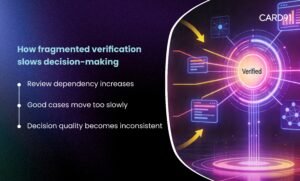
1. Review dependency increases
If systems cannot interpret the full picture clearly, cases are escalated by default.
2. Good cases move too slowly
Low-risk or manageable cases are delayed because workflows cannot distinguish them clearly from cases that need closer scrutiny.
3. Decision quality becomes inconsistent
Different teams or reviewers may interpret the same case differently because the system has not converted verification outputs into one structured action layer.
This is not only a verification issue. It is a workflow efficiency issue.
Most BFSI teams already run the required checks.
They validate identity, review documents, assess business details, apply fraud controls, and use rules-based logic in some form.
But when these signals sit across disconnected layers, institutions end up with more verification activity without better decision speed.
A case may complete KYC, show clean identity details, and still get delayed because one secondary signal appears weak in isolation. Another case may have a stronger overall profile, but still land in the same queue because the workflow cannot interpret the full signal picture consistently.
That is the real cost of fragmented verification.
Manual review becomes the fallback when systems cannot convert completed verification into a clear next step.
That usually happens when:
This is one of the reasons onboarding still depends heavily on manual intervention even after verification is complete. See Why BFSI Onboarding Still Depends on Manual Reviews — And What Needs to Change.
Consider two onboarding cases.
Case A
The applicant completes KYC, identity details align, and document quality is acceptable. One supporting signal is weaker than expected, but the broader profile remains strong.
Case B
The applicant also completes KYC, but multiple supporting signals are inconsistent, some details are incomplete, and the case requires closer review.
If verification remains fragmented, both cases may be routed the same way.
That is the problem.
Case A should not carry the same approval friction as Case B. But if workflows rely on isolated triggers instead of total signal interpretation, that distinction is often lost.
When onboarding slows down, many teams respond by adding more controls, more triggers, or more checks.
That may increase coverage, but it does not always improve decisions.
If additional checks are layered onto an already fragmented workflow, the institution can end up with more data and more delay at the same time.
The better approach is to unify the signals already being collected.
That means bringing identity checks, document validation, supporting data, and fraud-related indicators into one structured flow that supports clearer routing and faster action.
This is the broader shift behind verification intelligence in onboarding: moving from check completion to decision readiness.
Institutions that reduce delays caused by fragmented verification usually improve five things.
1. They unify signals before routing
Checks are interpreted together, not one by one.
2. They separate weak context from real risk
Not every unclear case is unsafe.
3. They reduce review-by-default logic
Manual review is used for true exceptions, not as the default response to uncertainty.
4. They improve decisioning after verification
Verification confirms what happened. Decisioning determines what should happen next.
5. They route using confidence, not just pass/fail outcomes
Cases move based on how strong, complete, and usable the overall signal picture is.
Confidence scoring helps institutions assess whether the available signals are strong enough to support action.
That matters because many onboarding delays come from low clarity, not just high risk.
When workflows can separate:
they can route more precisely and reduce unnecessary escalation.
That is why confidence scoring matters in modern onboarding. It helps convert fragmented verification outputs into clearer operational decisions. Read more in What Is a Confidence Score in BFSI Onboarding? Why It Matters More Than Risk Scores.
CARD91’s VerifyIQ is built around this gap.
It is designed to bring fragmented verification signals into one decision-ready flow so banks, NBFCs, and insurers can move from completed checks to clearer onboarding action.
That matters because fragmented verification is not just a visibility issue.
It directly affects approval speed, review dependency, and workflow efficiency.
As onboarding volumes grow across lending, cards, merchant identification, insurance, and account opening, the cost of fragmented verification becomes harder to ignore.
If checks are complete but cases still move slowly, institutions lose efficiency in two places:
That is why the next stage of BFSI onboarding is not just about verification coverage.
It is about making verification actionable.
KYC completion tells you the checks are done.
It does not always tell you whether the case is ready to move.
That is why fragmented verification remains a major cause of slower onboarding.
And that is why signal unification is becoming essential for institutions that want faster, cleaner, and more scalable decisions.
Q: What is fragmented verification in BFSI onboarding?
A: Fragmented verification in BFSI onboarding happens when checks are completed across different systems or layers, but are not interpreted together in a clear, decision-ready flow.
Q: Why does onboarding slow down even after KYC is complete?
A: Because KYC completion does not automatically create decision clarity. If signals remain disconnected, teams still struggle to decide whether a case should be approved, reviewed, rejected, or re-verified.
Q: How does fragmented verification increase manual review?
A: When systems cannot interpret the full signal picture clearly, they often escalate cases into manual review by default.
Q: How can banks and NBFCs reduce delays caused by fragmented verification?
A: They can reduce delays by unifying signals, separating uncertainty from real risk, improving post-verification decisioning, and routing cases using confidence-led logic.
Q: How does VerifyIQ help with fragmented verification?
A: VerifyIQ helps bring fragmented verification signals into one decision-ready flow, generate clearer confidence-led outcomes, and support faster onboarding actions.


To know more about our offerings connect with our experts