Subscribe to receive the latest blog posts to your inbox every week.
By subscribing you agree to with our Privacy Policy.
Merchant onboarding is critical.
But onboarding alone does not make an acquiring program scalable.
A merchant may submit documents, complete KYB, clear basic checks, and still not be equally ready for activation, control settings, or ongoing monitoring. Another merchant may complete onboarding but require a different go-live path based on category, business profile, transaction expectations, or risk context.
This is where many acquiring workflows still fall short.
They focus on onboarding completion, but not enough on merchant decisioning.
For banks, payment aggregators, and acquiring teams, that gap matters. Merchant growth depends not only on bringing merchants in quickly, but also on deciding how each merchant should be activated, routed, governed, and monitored after onboarding is complete.
Merchant decisioning in acquiring is the layer that determines what should happen after merchant onboarding and verification are complete.
It helps acquiring teams answer operational questions such as:
In practical terms, merchant onboarding collects and verifies information. Merchant decisioning determines the next operational action.
That distinction matters because a merchant can be onboarded without being equally ready for the same treatment as every other merchant.
Many acquiring workflows still treat merchant onboarding as the finish line.
Once KYB is complete, documents are verified, and the merchant profile is created, the workflow often assumes the next step is straightforward activation.
But that is not always the right outcome.
A merchant may look valid on submitted documents but still require closer review due to category alignment, expected transaction behaviour, ownership structure, business complexity, or mismatch between application inputs and operational risk posture.
Another merchant may be low-friction, operationally straightforward, and ready for fast activation, yet still face delay because the workflow does not distinguish clearly enough between “verified” and “decision-ready.”
That is where merchant decisioning becomes important.
The issue is usually not lack of onboarding checks.
The issue is the layer between:
merchant verification → merchant action
Without that layer, acquiring teams often end up with:
This is the same broader shift CARD91 has already explored in How AI Is Enabling Smarter Merchant Acquiring for Banks and Fintechs, where onboarding signals need to support sharper acquiring decisions.
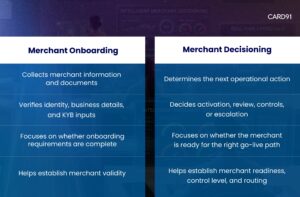
This is the difference many acquiring teams still under-design.
In UPI acquiring, scale, speed, compliance, merchant experience, and risk control all matter at the same time.
That means the real job of acquiring infrastructure is not only to onboard merchants.
It is to decide:
This is also why the merchant lifecycle matters beyond onboarding. CARD91 has already covered that broader operational view in From Risk to Revenue: Mapping the Full UPI Merchant Lifecycle with CARD91.
When merchant decisioning is weak, acquiring teams usually face one or more of these issues.
1. Activation-by-default
Merchants go live the same way once documents are complete, even if their risk or operational profile differs meaningfully.
2. Review-by-default
Merchants are pushed into manual review because the workflow cannot determine whether onboarding outputs are strong enough for action.
3. Weak control alignment
Different merchant types receive similar limits, controls, or monitoring setups even when they should not.
4. Delayed merchant go-live
Low-friction merchants wait because the workflow is not built to separate clear cases from exception cases.
5. Inconsistent classification and escalation
Merchant verification may exist, but activation and control decisions still depend too much on individual reviewer judgment.
These are not just onboarding issues. They affect scale, risk, and acquiring efficiency directly.
Acquiring teams with stronger merchant workflows usually improve five things.
1. They connect onboarding to action
They do not stop at KYB completion. They use onboarding outputs to support the next operational decision.
2. They distinguish merchant validity from merchant readiness
A verified merchant is not automatically ready for identical activation treatment.
3. They align controls to merchant context
Category, business model, expected behaviour, and risk posture should influence how a merchant is activated and monitored.
4. They reduce default review dependency
Manual review is used for true exceptions, not for every merchant the system cannot classify clearly enough.
5. They treat merchant decisioning as part of acquiring infrastructure
It is not a soft ops layer. It is a core part of scalable acquiring design.
Merchant decisioning depends on more than document correctness.
It depends on whether the acquiring workflow can interpret:
This is where merchant verification becomes more useful when it is connected to decisioning, not treated as an isolated compliance step.
That is also where CARD91’s merchant-side content on AI-Powered Merchant Onboarding: The Future of Secure and Compliant Acquiring and Onboarding to Scale: How AI-Driven Merchant Verification & MCC Mapping Reduces Risk and Boosts Efficiency fits naturally.
Two merchants may both complete onboarding successfully and still require different activation paths.
Merchant A
A low-friction merchant with consistent business details, clear category alignment, clean verification outputs, and a straightforward go-live profile.
Merchant B
A merchant with valid documents, but higher-risk category exposure, mixed business indicators, or a profile that needs tighter post-activation monitoring and stronger controls.
If the acquiring workflow treats both merchants the same way, it either:
That is why merchant decisioning matters.
It helps acquiring teams apply the right action, not just complete the same onboarding steps for everyone.
CARD91’s acquiring and AI-led merchant workflows already point in this direction.
They are built around a broader model where onboarding is only the beginning. The real goal is to convert merchant signals into faster, more accurate, and more scalable acquiring decisions.
That is also consistent with CARD91’s product direction across merchant verification, classification, onboarding, controls, and acquiring infrastructure.
If the operational goal is to improve merchant go-live without weakening control, then onboarding outputs need to support clearer action after verification.
Merchant acquiring is getting more complex, not less.
As banks and fintechs expand merchant networks across categories, channels, and business models, they need workflows that do more than onboard quickly. They need workflows that activate merchants intelligently, apply controls precisely, and reduce avoidable operational drag.
If merchant onboarding remains disconnected from merchant decisioning, teams usually pay the cost in three places:
That is why the next phase of acquiring is not just about faster onboarding.
It is about better merchant decisioning.
Merchant onboarding gets merchants into the system.
Merchant decisioning determines how they should move through it.
That is the layer many acquiring teams still under-design.
And that is where stronger acquiring infrastructure creates real advantage.
Q: What is merchant decisioning in acquiring?
A: Merchant decisioning in acquiring is the layer that determines what should happen after merchant onboarding is complete, including activation, review, controls, escalation, and monitoring paths.
Q: Why is merchant onboarding not enough on its own?
A: Because onboarding confirms merchant information and verification status, but does not automatically decide how the merchant should be activated, controlled, or monitored.
Q: How is merchant decisioning different from merchant onboarding?
A: Merchant onboarding focuses on collecting and verifying merchant information. Merchant decisioning focuses on operational action after verification, such as activation path, control level, and review requirement.
Q: Why does merchant decisioning matter in UPI acquiring?
A: Because UPI acquiring needs speed, compliance, merchant experience, and risk control at the same time. Merchant decisioning helps teams apply the right go-live and control model for each merchant.
Q: How can acquiring teams improve merchant decisioning?
A: They can improve merchant decisioning by connecting onboarding outputs to activation logic, aligning controls to merchant context, reducing review-by-default workflows, and using merchant verification and classification more operationally.


To know more about our offerings connect with our experts