Subscribe to receive the latest blog posts to your inbox every week.
By subscribing you agree to with our Privacy Policy.
Efficient credit line on UPI repayments and autopay are essential for portfolio health and customer experience.
In Credit Line on UPI (CLOU), repayment behaviour is not a back-office process — it is a real-time risk signal.
Unlike card portfolios with fixed billing cycles or loans with scheduled EMIs, CLOU operates on a continuously revolving credit model. Limits reduce with every transaction and replenish instantly upon repayment. This makes repayment orchestration central to exposure management.
These repayment flows operate within the broader framework of issuer-led Credit Line on UPI implementation, where lifecycle, risk, and reporting are tightly integrated from day one.
This article explains how banks design repayment systems and Autopay controls to safely close the credit loop in CLOU programs.
Each credit line is assigned a unique UPI handle.
Any payment made to this handle is treated as:
This ensures:
Banks typically support multiple repayment channels:
Customers can repay by:
This offers flexibility but relies on customer discipline.
UPI Autopay allows banks to:
Autopay can be configured for:
Banks may link credit availability to autopay status, strengthening risk control.
To improve accessibility, CLOU also supports:
All modes route through the CLMS, ensuring consistent accounting.
Repayments complete the operational loop described in the full Credit Line on UPI lifecycle from pre-sanction to collections, where utilisation, repayment, and exposure continuously interact.
One of CLOU’s defining features is instant credit replenishment.
As soon as repayment is received:
This real-time loop:
Banks embed risk logic into repayment behaviour, including:
Because repayments are real time, controls trigger instantly, not at month-end.
When repayments are delayed:
This tight coupling ensures early loss containment.
This dynamic adjustment of exposure forms part of issuer-grade risk controls in Credit Line on UPI, where repayment behaviour directly influences portfolio stability.
UPI-native repayments provide banks:
These advantages compound as CLOU portfolios scale.
CARD91 enables banks to manage CLOU repayments through its integrated CLMS and UPI switch.
With CARD91, banks can:
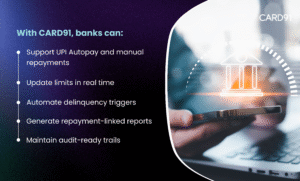
This ensures repayments strengthen—not weaken—CLOU governance.
In Credit Line on UPI, repayments determine sustainability.
Banks that design strong repayment and autopay frameworks:
Repayments are not the end of the CLOU journey—they are the feedback loop that keeps it healthy.
Want to optimise repayments and Autopay for Credit Line on UPI?
See how CARD91’s CLOU platform enables real-time repayment control and visibility. Book a Demo


To know more about our offerings connect with our experts