Subscribe to receive the latest blog posts to your inbox every week.
By subscribing you agree to with our Privacy Policy.
Reducing review backlogs in BFSI onboarding is a common goal for banks and NBFCs. However, many teams try to solve it in the wrong way.
They try to clear the backlog by pushing more cases through faster.
That may improve numbers for a while. However, it often creates a different problem: weaker control.
A strong onboarding workflow should not force a choice between speed and discipline. Instead, it should help teams reduce unnecessary review load while still protecting decision quality.
That is where better routing, cleaner queue design, and stronger clarification paths start to matter.
Most review backlogs do not happen because teams are too slow.
They happen because too many cases enter review in the first place.
This typically happens for four reasons:
This is also why What Should Trigger Manual Review in BFSI Onboarding? A Practical Decision Framework and Digital Onboarding Workflow Gaps: How Banks and NBFCs Can Improve Routing and Decision Quality matter so much operationally.
To reduce review backlogs in BFSI onboarding, teams need to improve the workflow before cases ever reach review.
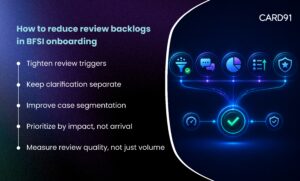
Not every unclear case belongs in review. Review should be reserved for decision-sensitive cases where human judgment adds real value.
Cases needing more information should not compete with sensitive review cases in the same queue.
This is also why What Good Clarification Workflow Design Looks Like in Digital Onboarding matters so much.
Decision-ready, clarification, review, and negative-outcome cases should not move through the same broad logic.
That is also the core logic behind BFSI Onboarding Case Segmentation: How Banks and NBFCs Can Improve Speed and Control.
If all review cases are treated equally, backlog becomes flatter and less manageable.
Instead, teams should prioritize cases based on:
That is where Queue Priority in BFSI Onboarding: How Ops Teams Should Triage Cases becomes highly relevant.
Reducing backlog is not enough if the wrong cases are still entering review.
This is why BFSI Onboarding Operations Metrics: What Good Ops Teams Track After Onboarding is an important companion read.
A review backlog is not just a speed issue.
It is a workflow issue.
If the wrong cases keep entering review, faster reviewer effort only treats the symptom. Instead, teams must address the source of the problem.
That is why stronger BFSI teams focus on:
They do not use review as the default safety net.
They fix routing upstream instead of pushing more work downstream.
Missing information and decision-sensitive exceptions are not the same thing.
They improve queue quality, not just reviewer throughput.
This is also why Decision Consistency in BFSI Onboarding: How Teams Can Improve Outcomes Across Queues matters. Cleaner routing supports cleaner backlog behavior.
CARD91’s VerifyIQ fits directly into this problem because reducing review backlog depends on stronger upstream signal interpretation and cleaner routing.
If more cases can be placed into the right path earlier, review queues become smaller, cleaner, and more useful.
That matters because strong onboarding control is not about reviewing more cases. It is about reviewing the right ones.
A strong onboarding workflow does not reduce backlog by lowering standards.
It reduces backlog by sending fewer wrong cases into review.
That is how banks and NBFCs move faster without losing control.
A: They usually happen because too many cases enter review by default instead of being routed more precisely upstream.
A: Yes. The goal is to reduce unnecessary review entry rather than lower decision standards.
A: Because they solve different problems. Clarification is for recoverable cases needing more information, while review is for decision-sensitive cases needing human judgment.
A: It keeps decision-ready, clarification, review, and negative-outcome cases from getting mixed into the same broad workflow path.
A: VerifyIQ helps improve signal interpretation and routing so more cases can move through the right path earlier, reducing unnecessary review load.
To know more about our offerings connect with our experts
Sales: sales@card91.io
HR: careers@card91.io
Media: comms@card91.io
Support: support@card91.io