Introduction: CLOU Is a Continuous Credit Lifecycle
Credit Line on UPI (CLOU) is not a one-time credit event. Unlike loans with fixed disbursements or cards with periodic billing cycles, CLOU operates as a continuous credit lifecycle—where spending, repayment, utilisation, and risk evolve in real time.
For banks, understanding the end-to-end CLOU lifecycle is essential to designing controls, operations, and reporting that scale safely.
This article breaks down the full Credit Line on UPI lifecycle, from pre-sanctioning to collections, through an issuer’s lens.
At this stage, no UPI transaction occurs—but risk boundaries are already locked in.
Stage 2: Credit Scheme Configuration
Banks configure CLOU product schemes within the CLMS, such as:
Interest-free revolving credit
Interest-bearing revolving credit
EMI-based term credit
Collateral-backed credit lines
Each scheme defines:
Billing logic
Interest computation
Minimum due amounts
Regulatory classification
This allows banks to run multiple CLOU products simultaneously without operational complexity.
Stage 3: Discovery on UPI Apps
Once credit lines are created, eligible customers can discover Credit Line on UPI on:
Bank mobile apps
Other banks’ apps
TPAP platforms
Discovery is typically based on:
Registered mobile number
Customer identifier mapping
At this stage, CLOU becomes visible—but not yet usable.
Stage 4: Customer Consent & Activation
Before activation, customers must:
Review credit line details
Provide explicit consent
Accept terms aligned with Digital Lending Guidelines
Set a UPI PIN
A unique UPI handle is generated for each credit line account. This handle becomes the single identifier for all CLOU transactions and repayments.
Stage 5: Spend & Utilisation
Once activated, customers can:
Scan QR codes
Pay at online checkouts
Select Credit Line on UPI as the payment source
During each transaction:
CLMS validates available credit
Risk controls are enforced
Limits are updated in real time
Some schemes allow instant EMI conversion at checkout.
Stage 6: Repayment & Credit Replenishment
Repayments flow directly into the unique UPI handle linked to the credit line.
Repayment modes include:
UPI Autopay
Manual UPI payments
IMPS / NEFT / standing instructions
As repayments are received:
Outstanding balance reduces
Available credit is replenished instantly
Risk posture adjusts dynamically
Stage 7: Delinquency Monitoring & Collections
The CLMS continuously computes:
Days Past Due (DPD)
Delinquency buckets
Asset classification
Banks can trigger:
Dynamic credit suspension
Partial or full freezes
Collection workflows (tele, field, agency)
This ability to suspend, reinstate, and escalate exposure dynamically is a core part of issuer-grade risk controls in Credit Line on UPI, enabling early loss containment without manual intervention.
Stage 8: Reporting, Compliance & Closure
Throughout the lifecycle, the system generates:
Regulatory reports
Bureau submissions
Audit trails
Portfolio analytics
When required, credit lines can be:
Closed
Renewed
Restructured
The CLOU lifecycle thus remains fully traceable and regulator-ready from start to finish.
How CARD91 Enables End-to-End CLOU Lifecycle Management
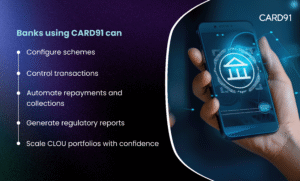
CARD91 provides a unified Credit Line Management System (Nimbus) that governs the entire CLOU lifecycle on a single platform.
Banks using CARD91 can:
Configure schemes
Control transactions
Automate repayments and collections
Generate regulatory reports
Scale CLOU portfolios with confidence
Conclusion: CLOU Is a Lifecycle, Not a Product
Banks that treat Credit Line on UPI as a feature often struggle operationally. Banks that design for the full lifecycle build sustainable, compliant CLOU portfolios.
Understanding—and governing—this lifecycle is the foundation of CLOU success.
Looking to manage the full Credit Line on UPI lifecycle seamlessly? See how CARD91’s CLMS supports CLOU from pre-sanction to collections. Book a Demo