Home / Blogs 

Why Banks Need a Credit Line Management System for Credit Line on UPI

Why Banks Need a Credit Line Management System for Credit Line on UPI

4 minutes read

Table of contents

Subscribe to newsletter

Subscribe to receive the latest blog posts to your inbox every week.

By subscribing you agree to with our Privacy Policy.

A credit line management system for banks is essential to control lifecycle, limits, repayments, and compliance for credit line on UPI.

Introduction: CLOU Cannot Be Managed Like Cards or Loans

As Credit Line on UPI (CLOU) moves into production across banks, many institutions initially attempt to manage it using existing loan systems or card management platforms.

This approach works briefly—but breaks at scale.

Credit Line on UPI is neither a traditional loan nor a card product. It is an account-based, UPI-native credit instrument that operates in real time across payments, repayments, and collections.

To run CLOU safely and compliantly, banks need a dedicated Credit Line Management System (CLMS)—not workarounds.

This article explains why a CLMS is essential for banks launching or scaling Credit Line on UPI.

What Is a Credit Line Management System (CLMS)?

A Credit Line Management System is the issuer’s system of record and control for all CLOU activities.

It manages the entire lifecycle of a credit line, including:

  • Credit scheme configuration

  • Credit line account creation

  • Real-time limit management

  • Transaction authorisation logic

  • Repayments and delinquency

  • Regulatory and bureau reporting

In short, the CLMS sits between the UPI switch and the bank’s core systems, enforcing credit logic at every step.

Why Core Loan Systems Are Not Enough for CLOU

Traditional Loan Management Systems (LMS) are designed for:

  • Fixed disbursements

  • Scheduled repayments

  • Batch processing

  • Limited real-time interaction

Credit Line on UPI, by contrast, requires:

  • Real-time authorisation

  • Continuous limit utilisation tracking

  • Instant repayment reflection

  • Dynamic suspension and reinstatement

  • UPI-native transaction handling

Trying to retrofit CLOU into an LMS results in:

  • Manual reconciliations

  • Delayed limit updates

  • Higher fraud exposure

  • Audit and compliance risk

Why Card Systems Also Fall Short

Card Management Systems (CMS) are optimised for:

  • Card numbers and BINs

  • Card billing cycles

  • Card-centric risk models

CLOU operates differently:

  • Credit is linked to a UPI handle, not a card

  • Repayments flow directly to the account

  • Controls must be applied at account and merchant level

  • Credit behaviour is closer to digital lending, not card spends

As a result, card systems cannot provide:

  • End-to-end CLOU lifecycle visibility

  • UPI-native repayment tracking

  • Flexible scheme-level credit controls

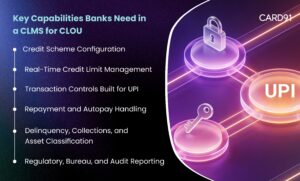
Key Capabilities Banks Need in a CLMS for CLOU

Key Capabilities Banks Need in a CLMS for CLOU 
1. Credit Scheme Configuration

A CLMS allows banks to configure multiple CLOU products, such as:

  • Interest-free revolving credit


  • Interest-bearing revolving credit


  • EMI-based term credit


  • Secured and unsecured credit lines


Each scheme can define:

  • Interest logic


  • Fees and penalties


  • Billing cycles


  • Regulatory classification


This flexibility is critical as banks experiment with different CLOU use cases.

2. Real-Time Credit Limit Management

Unlike loans, CLOU limits change continuously.

A CLMS enables:

  • Real-time utilisation tracking


  • Dynamic limit adjustments


  • Immediate suspension on delinquency


  • Controlled reinstatement after repayment


Without this, banks risk over-exposure and delayed risk response.

3. Transaction Controls Built for UPI

A CLMS enforces issuer-defined controls during every transaction:

  • MCC restrictions


  • Velocity checks


  • Transaction value limits


  • Use-case-based restrictions (P2M only, exclusions, etc.)


These controls operate before authorisation, reducing fraud and misuse.

4. Repayment and Autopay Handling

CLOU repayments are fundamentally different from loan EMIs.

A CLMS supports:

  • Repayments into unique UPI handles


  • UPI Autopay mandates


  • Partial and full repayments


  • IMPS, NEFT, and standing instructions


Repayments immediately update available credit, improving customer experience and control.

5. Delinquency, Collections, and Asset Classification

A CLMS continuously computes:

  • Days Past Due (DPD)


  • Delinquency buckets


  • Asset classification


  • Income recognition


It also integrates with issuer-defined:

  • Tele-collection workflows


  • Field or agency collections


  • Portfolio actions and reporting


This ensures CLOU portfolios remain regulator-ready at all times.

6. Regulatory, Bureau, and Audit Reporting

Credit Line on UPI is subject to:

  • Digital Lending Guidelines


  • NPCI requirements


  • RBI reporting expectations


A CLMS generates:

  • Regulatory reports


  • Bureau submissions


  • Audit-ready transaction trails


  • Consent and disclosure logs


Without a CLMS, compliance becomes manual—and risky.

Operational Risks of Launching CLOU Without a CLMS

Banks attempting CLOU without a dedicated CLMS often face:

  • Reconciliation mismatches

  • Delayed customer issue resolution

  • Inconsistent credit reporting

  • Higher operational costs

  • Increased audit observations

At scale, these issues directly impact portfolio health and regulator confidence.

How CARD91 Supports CLMS-Led CLOU Implementation

CARD91 offers a configurable Credit Line Management System (Nimbus) designed specifically for banks launching Credit Line on UPI.

With CARD91’s CLMS, banks can:

  • Configure and manage multiple CLOU products on a single platform

  • Apply real-time credit and transaction controls

  • Integrate seamlessly with an NPCI-certified UPI switch

  • Automate repayments, delinquency, and reporting

  • Retain full issuer control over credit policy and operations

This infrastructure-led approach allows banks to scale CLOU portfolios securely and compliantly.

Conclusion: CLMS Is Not Optional for CLOU

Credit Line on UPI is redefining digital credit—but it demands a new operating model.

Banks that succeed with CLOU will:

  • Treat it as core infrastructure

  • Invest in dedicated lifecycle management

  • Build real-time controls into the stack

  • Ensure continuous regulatory readiness

A Credit Line Management System is not an enhancement—it is the foundation for sustainable CLOU programs.

FAQs: Credit Line Management System for CLOU

Q: What is a Credit Line Management System (CLMS)?
A: A CLMS is a platform that manages the full lifecycle of Credit Line on UPI—from scheme setup and transactions to repayments, delinquency, and reporting.

Q: Can banks launch CLOU without a CLMS?
A: Technically yes, but operationally risky. Without a CLMS, banks face reconciliation issues, delayed controls, and compliance gaps.

Q: Is a CLMS different from a Loan Management System?
A: Yes. A CLMS is built for real-time, revolving, UPI-native credit, unlike traditional LMS platforms.

Planning to launch or scale Credit Line on UPI? See how CARD91’s Credit Line Management System helps banks run CLOU with control, compliance, and confidence. Book a Demo

Share this post

Read more

4 minutes read

In a world that has moved to the internet and the mobile, data privacy is paramount. This is more evident

3 minutes read

As India advances in its digital transformation journey, the payments landscape is rapidly evolving

Start modernising your payments with CARD91 infrastructure

To know more about our offerings connect with our experts