Subscribe to receive the latest blog posts to your inbox every week.
By subscribing you agree to with our Privacy Policy.
Digital onboarding does not break down only when checks are missing.
It also breaks down when too many different cases are pushed into the same queue.
A low-friction applicant, a case missing one document, and a genuinely sensitive profile often end up in the same review flow. When that happens, operations teams lose prioritization, good cases get delayed, and exception handling becomes wider than it needs to be.
That is why exception queue design matters.
For banks, NBFCs, and insurers, an exception queue is not just an operations bucket. It is an important part of the onboarding decision system. That is also why topics like Verification Intelligence in Onboarding: What BFSI Teams Need Beyond Basic KYC and Why BFSI Onboarding Still Depends on Manual Reviews — And What Needs to Change matter so much in practice.
An exception queue in digital onboarding is the route where cases go when they cannot move forward through standard approve, reject, or re-verify paths alone.
In practice, this queue should contain only cases that need special handling because of:
This distinction matters because not every imperfect case is a true exception. Strong onboarding teams know how to separate recoverable operational gaps from decision-sensitive exception cases.
Exception queues usually become ineffective when escalation logic is too broad.
That often happens when:
The result is predictable:
This is also why How Banks and NBFCs Can Reduce False Positives in Digital Onboarding and Why Fragmented Verification Slows BFSI Decision-Making — Even After KYC Is Complete are closely connected to this discussion.
Good BFSI ops teams do not overload exception queues with cases that belong elsewhere.
1. Missing but recoverable inputs
If a case simply needs clarification or one additional document, it usually belongs in re-verification, not exception handling.
2. Low confidence without meaningful sensitivity
A case may need more clarity without requiring human judgment. This is where What Is a Confidence Score in BFSI Onboarding? Why It Matters More Than Risk Scores becomes operationally relevant.
3. Minor signal weakness
One weak supporting signal should not outweigh an otherwise strong case unless it materially changes the decision context.
4. Cases delayed by poor segmentation
If the workflow cannot properly separate clear cases from ambiguous ones, that is a routing problem, not a reason to use the exception queue.
This is also why What Happens After Verification in BFSI Onboarding? Why Post-Verification Decisioning Is the Missing Layer matters in real onboarding workflows.
Strong teams usually design exception queues around four principles.
1. They define exception categories clearly
They do not rely on one broad “review” bucket.
Instead, they separate:
This improves prioritization and makes queue handling more consistent.
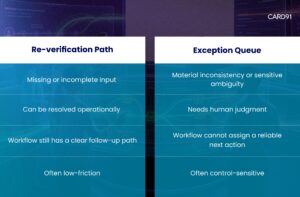
2. They separate re-verification from exception handling
This is one of the most important distinctions.
3. They prioritize by impact, not just by arrival
Not every exception case has the same urgency.
More mature teams structure queues around:
That is how they prevent exception queues from becoming flat review backlogs.
4. They connect exception handling to upstream decisioning
Exception queues work best when upstream workflows already do more of the filtering.
That means stronger signal interpretation, tighter routing logic, and a clearer distinction between Verification vs Risk Scoring vs Decisioning in BFSI: Key Differences Explained.
CARD91’s VerifyIQ fits naturally into this workflow because stronger exception queues depend on better upstream signal interpretation, confidence-led routing, and clearer approve/review/reject decision paths.
That matters because exception queue quality is not only about downstream handling. It depends on how well the workflow interprets and routes cases before they ever reach that point.
A poor exception queue captures everything.
A strong exception queue captures only what truly needs exception handling.
That is what better BFSI ops teams do differently.
Q: What is an exception queue in digital onboarding?
A: An exception queue is the route where cases go when standard approve, reject, or re-verify paths are not enough and special handling is needed.
Q: What should not go into an exception queue?
A: Cases needing simple clarification, minor recoverable gaps, or low-confidence but low-sensitivity outcomes should usually stay out of the exception path.
Q: Why do exception queues become overloaded?
A: They become overloaded when re-verification cases, low-friction cases, and true exception cases are all sent to the same queue.
Q: How do good BFSI ops teams design exception queues?
A: They separate exception categories, distinguish re-verification from exception handling, prioritize by impact, and improve upstream routing.
Q: How does VerifyIQ help?
A: VerifyIQ helps unify verification signals, improve confidence-led routing, and support clearer approve, review, or reject decision paths.
To know more about our offerings connect with our experts
Sales: sales@card91.io
HR: careers@card91.io
Media: comms@card91.io
Support: support@card91.io