Subscribe to receive the latest blog posts to your inbox every week.
By subscribing you agree to with our Privacy Policy.
Banks often evaluate credit line on UPI and credit cards as complementary products rather than substitutes.
As Credit Line on UPI (CLOU) gains momentum, banks are increasingly asked a strategic question:
Is CLOU meant to replace credit cards?
The short answer is no.
CLOU and credit cards are fundamentally different credit instruments, built on different rails, with different risk models, customer behaviours, and operating economics. Treating them as substitutes leads to poor product decisions and misaligned expectations.
This comparison builds on how banks design multi-rail credit portfolios on UPI, where CLOU and card-based credit serve complementary but distinct roles.
This article explains how banks should compare Credit Line on UPI and credit cards, and how both fit into a modern issuer’s credit portfolio.
Credit Line on UPI allows banks to offer pre-sanctioned, account-based credit lines that customers can access directly via UPI apps using a unique UPI handle.
Key characteristics:
CLOU behaves closer to digital lending infrastructure than to traditional card products.
Credit cards are card-based revolving credit products operating on card networks and governed by card billing cycles.
Key characteristics:
Cards are optimised for high-value spends, cross-border usage, and long-tenure customer relationships.
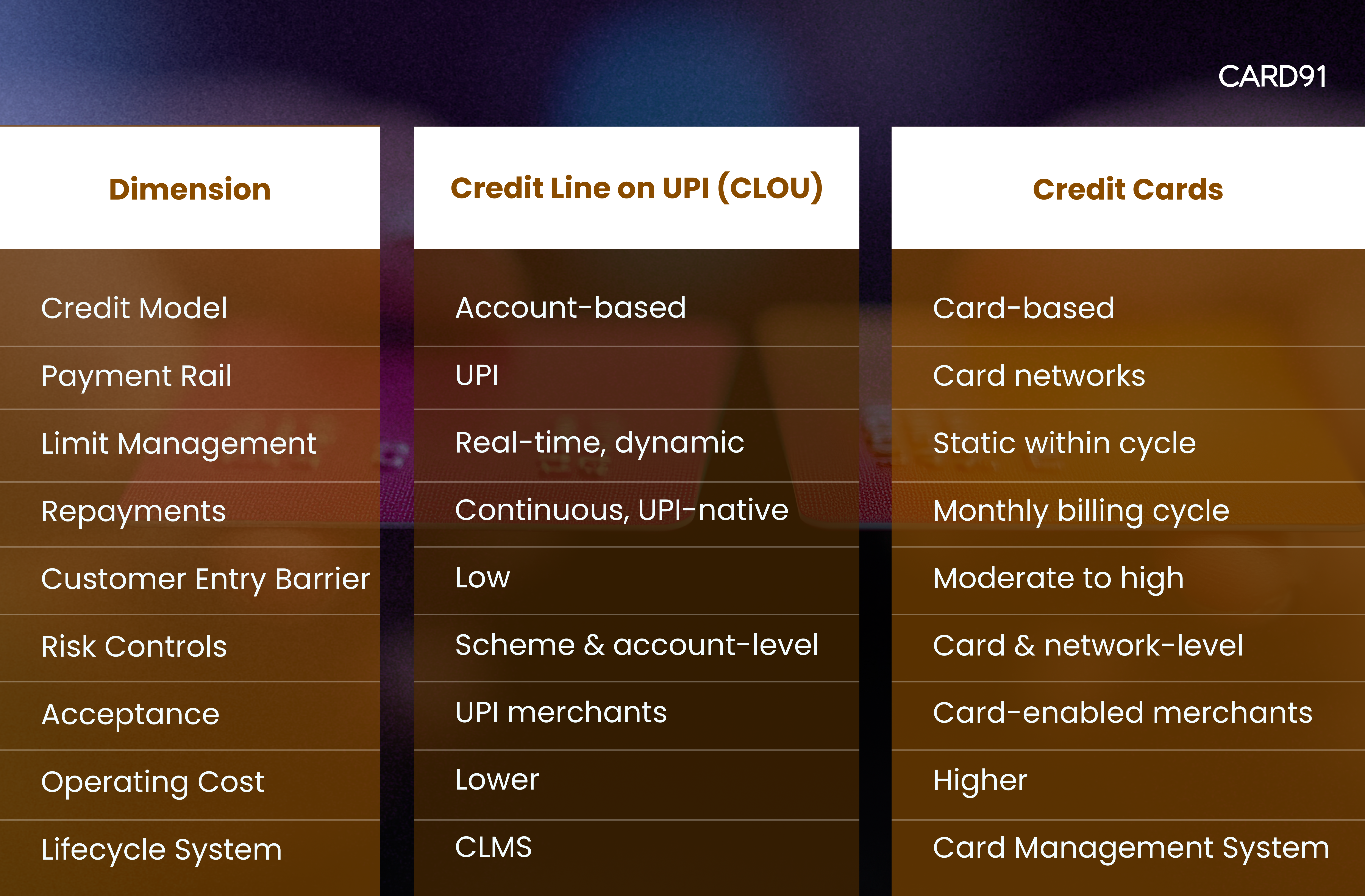
These differences are reflected in issuer-grade CLOU architecture, where lifecycle management and authorisation controls operate separately from card systems.
As a result, banks implement rail-specific risk controls in Credit Line on UPI, rather than applying uniform card-centric models.
CLOU gives issuers more direct control, while cards rely more heavily on network governance.
These behaviours are complementary, not competitive.
From a bank’s perspective:
A balanced portfolio uses both instruments to optimise risk-adjusted returns.
Forward-looking banks increasingly follow a dual-rail strategy:
CLOU often acts as a feeder product, helping banks graduate customers into card portfolios over time.
CARD91 enables banks to operate both Credit Line on UPI and card programs through issuer-grade infrastructure.
With CARD91, banks can:
This allows banks to expand credit access without cannibalising existing card businesses.
Credit Line on UPI is not the future replacement of credit cards—it is the future expansion of digital credit access.
Banks that succeed will:
The winners will be issuers that build cohesive credit portfolios, not isolated products.
Is Credit Line on UPI cheaper than credit cards for banks?
Yes. CLOU generally has lower operational and servicing costs.
Can CLOU replace credit cards completely?
No. Cards remain essential for premium, international, and high-value use cases.
Do banks need separate systems for CLOU and cards?
Yes. CLOU requires a CLMS, while cards require a card management system.
Looking to build a balanced CLOU and credit card strategy?
See how CARD91 helps banks launch and scale both credit rails with full issuer control. Book a Demo


To know more about our offerings connect with our experts