Subscribe to receive the latest blog posts to your inbox every week.
By subscribing you agree to with our Privacy Policy.
As UPI matures into a core financial rail, banks are no longer extending credit through a single product. Instead, they are designing multi-rail credit portfolios that combine different credit instruments on the same payment infrastructure.
Banks increasingly design credit line on UPI and card-based credit together to serve different payment and credit use cases—without forcing one product to replace the other.
Two models are commonly deployed:
These models are often misunderstood as competing options. In practice, banks use both together as part of a cohesive, issuer-controlled credit strategy.
This combined approach reflects how banks operationalise Credit Line on UPI in practice, where CLOU and card-based credit are implemented as distinct but coordinated products within a broader issuer strategy, as outlined in how banks implement Credit Line on UPI.
Designing multiple credit instruments on the same payment rail requires issuers to manage separate lifecycles, controls, and reporting layers, which is why banks rely on a dedicated system architecture rather than treating UPI credit as a single product layer.
UPI today supports:
However, credit behaviour is not uniform across customers, merchants, or transaction contexts.
Banks therefore need:
This naturally leads to a multi-rail credit architecture, where different credit instruments coexist on the same payment rail without operational conflict.
In most implementations, this lifecycle governance is enforced through a dedicated system layer, making it clear why banks need a Credit Line Management System for Credit Line on UPI to operate CLOU safely at scale.Credit Line on UPI (CLOU) allows banks to offer:
CLOU is commonly used for:
From an issuer perspective, CLOU behaves like UPI-native digital lending infrastructure, not a card substitute.
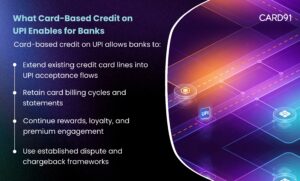
This model is typically applied to:
Importantly, card-based credit on UPI is network-agnostic, operating across all major card networks without dependency on any single ecosystem.
Many banks treat CLOU as an entry rail within a broader issuer-led rollout, following a phased approach similar to the one described in practical issuer-led Credit Line on UPI implementations.
Forward-looking banks do not choose one model over the other.
They design complementary credit rails:
In many portfolios, CLOU acts as a feeder rail, allowing banks to observe repayment behaviour and transaction discipline before graduating customers into card-based credit products.
Although both models operate on UPI, backend systems must remain distinct.
Banks typically operate:
This separation of systems is part of a broader issuer-side architecture for Credit Line on UPI, where CLOU and card credit share the payment rail but not the same lifecycle or risk engines.This separation ensures:
Banks that succeed avoid forcing uniform controls by implementing rail-specific risk governance for Credit Line on UPI, while allowing card portfolios to continue operating under network-defined risk frameworks.Risk governance varies by rail:
Banks that recognise these differences avoid forcing uniform risk logic across fundamentally different credit instruments.
CARD91 enables banks to operate Credit Line on UPI and card-based credit programs across all major networks, without architectural or operational bias.
With CARD91, banks can:
This positions CARD91 as a network-agnostic, issuer-first infrastructure partner.
The future of UPI credit is not about choosing one rail over another.
A balanced portfolio combining credit line on UPI and card-based credit is becoming standard for banks.
Banks that succeed:
Multi-rail credit design is no longer optional—it is core to scalable UPI-based lending.
Q: How do banks use credit line on UPI and card-based credit together?
A: Banks deploy CLOU for high-frequency, real-time credit use cases and card-based credit for structured, billing-cycle-based portfolios.
Q: Is credit line on UPI a replacement for card-based credit?
A: No. CLOU complements card portfolios but does not replace them.
Q: Can the same infrastructure support credit line on UPI and card-based credit?
A: Yes, if lifecycle management, risk, and reporting systems are clearly separated.
Planning a network-agnostic, multi-rail UPI credit strategy?
See how CARD91 enables banks to operate Credit Line on UPI and card-based credit programs with full issuer control. Book a Demo


To know more about our offerings connect with our experts