Subscribe to receive the latest blog posts to your inbox every week.
By subscribing you agree to with our Privacy Policy.
Not every onboarding delay starts with risk.
Many start with a case that is simply incomplete, unclear, or missing one input.
The real problem begins when the workflow sends that case to manual review anyway.
That is where re-verification in BFSI onboarding starts to matter.
For banks and NBFCs, a clean BFSI onboarding re-verification workflow helps recover cases that can still move forward. It gives the workflow a way to request more clarity without turning every incomplete case into a review case.
A BFSI onboarding re-verification workflow is the operational path used when a case needs more information or confirmation before a final decision can be assigned.
In practical terms, this usually applies to:
That distinction matters.
Re-verification is not the same as review. Review is a decision path. Re-verification is a supporting process that helps the workflow reach a cleaner final decision.
This is also why BFSI Onboarding Workflow Design: How Teams Should Structure Approve, Review, and Reject Decisions matters operationally.
When re-verification is not designed clearly, workflows usually make one of two mistakes:
That creates familiar problems:
This is closely tied to What Should Trigger Manual Review in BFSI Onboarding? A Practical Decision Framework and Designing Exception Queues in Digital Onboarding: What Good BFSI Ops Teams Do Differently.
This is the workflow distinction that matters most.
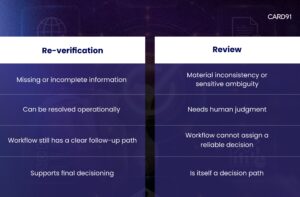
If these two paths get mixed, review becomes broader than it should be.
That is one of the main reasons manual review dependency in BFSI onboarding persists.
A cleaner digital onboarding workflow usually sends these cases into re-verification:
The case is otherwise workable, but one detail is missing.
The workflow needs confirmation before it can decide, but the case does not yet justify review.
Submitted information exists, but needs correction, confirmation, or resubmission.
The workflow needs more clarity, but the case is not automatically sensitive enough for review.
This is where What Is a Confidence Score in BFSI Onboarding? Why It Matters More Than Risk Scores becomes operationally useful.
Re-verification should not be used for:
Those belong in review, not re-verification.
That is also why Verification vs Risk Scoring vs Decisioning in BFSI: Key Differences Explained remains foundational to onboarding workflow design.
Stronger teams usually do four things better.
They avoid vague rules like “send back if unclear.”
The workflow clearly states what is missing, what needs correction, and what happens next.
Recoverable cases are not mixed with true exception cases.
Once the missing input is resolved, the case should move back into standard decisioning without avoidable delay.
This also supports the logic behind BFSI Onboarding Case Segmentation: How Banks and NBFCs Can Improve Speed and Control.
CARD91’s VerifyIQ is relevant here because its workflow model is built around stronger upstream signal interpretation, configurable routing into approve / review / reject paths, and additional re-verification rules for cases that need more clarity before a final decision. The product page also says VerifyIQ helps teams unify fragmented signals and generate a real-time confidence score for faster, more policy-aligned onboarding decisions.
A strong onboarding workflow does not send every unclear case to review.
It knows when the case simply needs more clarity first.
That is what good re-verification design helps teams do.
A: It is the workflow used when a case needs more information or confirmation before a final decision can be assigned.
A: No. Re-verification is an operational process for recoverable cases. Manual review is used when human judgment is needed.
A: Because recoverable cases get pushed into manual review instead of being resolved upstream.
A: Cases with missing inputs, clarity gaps, input-quality issues, or low confidence without meaningful risk usually fit re-verification better than review.
A: VerifyIQ helps improve signal interpretation and routing so incomplete but recoverable cases can follow cleaner re-verification paths instead of entering manual review.


To know more about our offerings connect with our experts