Home / Blogs 

BFSI Onboarding Escalation Design: When a Case Should Move to Review or Higher Scrutiny

BFSI onboarding escalation design

3 minutes read

BFSI onboarding escalation design matters because not every case should be handled at the same level.

Some cases are ready to move forward. Others need clarification. A smaller set needs review. Another set deserves higher scrutiny because the cost of a wrong decision is too high.

Problems start when workflows blur those levels together.

As a result, low-friction cases slow down, review queues get overloaded, and truly sensitive cases do not receive the attention they need.

For banks and NBFCs, stronger escalation design is not about escalating more cases. It is about escalating the right cases for the right reason.

What is BFSI onboarding escalation design?

BFSI onboarding escalation design is the workflow logic that determines when a case should stay in standard handling, move to review, or move to a stricter level of scrutiny.

In practical terms, a strong escalation model should answer:

  • when a case can stay in standard workflow
  • when a case needs review
  • when a case needs higher scrutiny
  • when a case only needs clarification before a final decision

That distinction matters because escalation is not the same as delay. It is a control decision.

This is also why BFSI Onboarding Workflow Design: How Teams Should Structure Approve, Review, and Reject Decisions and Digital Onboarding Workflow Gaps: How Banks and NBFCs Can Improve Routing and Decision Quality connect closely with escalation logic.

Why BFSI onboarding escalation design breaks down

Weak escalation design usually creates one of two problems:

  • teams escalate too many cases too early
  • teams do not separate truly sensitive cases clearly enough from routine review work

That leads to familiar outcomes:

  • review queues become broader than they should be
  • good cases get delayed unnecessarily
  • clarification cases compete with decision-sensitive cases
  • control becomes less precise even as friction increases

This is also why What Should Trigger Manual Review in BFSI Onboarding? A Practical Decision Framework and Queue Priority in BFSI Onboarding: How Ops Teams Should Triage Cases matter operationally.

How BFSI onboarding escalation design should work

A stronger escalation model should move cases upward only when the workflow has a clear reason to do so.
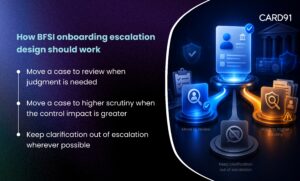
1. Move a case to review when judgment is needed

A case should move to review when standard workflow logic cannot assign a reliable decision on its own.

That usually happens when there is:

  • material inconsistency
  • meaningful ambiguity
  • control-sensitive uncertainty
  • decision complexity that needs human judgment

2. Move a case to higher scrutiny when the control impact is greater

Higher scrutiny should be reserved for cases where the downside of a wrong decision is meaningfully higher.

That may include:

  • stronger control sensitivity
  • multiple concern signals appearing together
  • cases where standard review is not enough
  • cases with deeper policy, compliance, or risk implications

3. Keep clarification out of escalation wherever possible

Cases that simply need more information should not compete with truly sensitive cases.

This is also why What Good Clarification Workflow Design Looks Like in Digital Onboarding matters so much.

What should stay out of escalation

A stronger escalation model also depends on knowing what should not move up.

These cases often do not need review or higher scrutiny:

  • missing but recoverable information
  • input-quality issues that teams can correct operationally
  • low-confidence cases without meaningful sensitivity
  • cases delayed only because routing is weak

Teams usually handle those cases better handled through clarification, not escalation.

This is also why BFSI Onboarding Case Segmentation: How Banks and NBFCs Can Improve Speed and Control and Decision Consistency in BFSI Onboarding: How Teams Can Improve Outcomes Across Queues are important companion topics.

What stronger BFSI teams do differently

1. They define escalation triggers clearly

They do not rely on vague labels like “send for higher attention.”

2. They separate clarification from escalation

Cases needing more information should not compete with truly sensitive cases.

3. They distinguish review from higher scrutiny

Not every reviewed case needs the same control intensity.

4. They align escalation with queue design

Escalation works best when queue priority, routing logic, and decision thresholds are already clean upstream.

This is also why How Banks and NBFCs Can Reduce Review Backlogs Without Weakening Control matters so much.

Where CARD91 fits

CARD91’s VerifyIQ fits naturally into this problem because stronger escalation design depends on better upstream signal interpretation, confidence-led triage, and cleaner routing.

A case should not move to review or higher scrutiny just because the workflow is uncertain. It should move there because the workflow has a clear reason to escalate it.

That is where better routing discipline becomes valuable.

Key takeaways

  • BFSI onboarding escalation design should determine when a case stays in standard flow, moves to review, or needs higher scrutiny.
  • Review and higher scrutiny should not be treated as the same level of handling.
  • Clarification cases should stay out of escalation wherever possible.
  • Stronger escalation design reduces friction without weakening control.
  • Better upstream routing leads to cleaner escalation decisions downstream.

Final thought

A strong onboarding workflow does not escalate every unclear case.

It escalates only the cases that truly deserve a higher level of attention.

That is what better BFSI onboarding escalation design helps teams achieve.

Book a VerifyIQ demo

FAQs

Q: What is BFSI onboarding escalation design?

A: It is the workflow logic that determines when a case should stay in standard handling, move to review, or move to higher scrutiny.

Q: When should a case move to review?

A: A case should move to review when human judgment is needed because the workflow cannot assign a reliable decision through standard logic alone.

Q: When should a case move to higher scrutiny?

A: A case should move to higher scrutiny when the case has greater control sensitivity, stronger concern signals, or a higher-impact downside if handled incorrectly.

Q: Should clarification cases be escalated?

A: Not usually. Cases needing more information are often better handled through clarification, not review or higher scrutiny.

Q: How does VerifyIQ help?

A: VerifyIQ helps improve signal interpretation and routing so escalation decisions can be made more clearly and consistently.

Share this post

Read more

4 minutes read

In a world that has moved to the internet and the mobile, data privacy is paramount. This is more evident

3 minutes read

As India advances in its digital transformation journey, the payments landscape is rapidly evolving

Start modernising your payments with CARD91 infrastructure

To know more about our offerings connect with our experts