Subscribe to receive the latest blog posts to your inbox every week.
By subscribing you agree to with our Privacy Policy.
A digital onboarding workflow is only as strong as the decisions it helps teams make.
That is where many BFSI teams still struggle.
A case may complete KYC and still not be ready for approval. Another may not be risky enough to reject, but still not be clear enough to move forward. And in many workflows, that uncertainty ends up in one place: review.
That is where routing starts to break.
For banks, NBFCs, and insurers, a strong BFSI onboarding workflow is not just about collecting documents and running checks. It is about moving cases into the right decision path: approve, review, or reject.
A BFSI onboarding workflow is the structure that determines how a case moves through digital onboarding after inputs are collected and signals are assessed.
In practical terms, the workflow should be able to answer:
That matters because digital onboarding is not just about completing steps. It is about assigning the right next action.
This is also why Verification Intelligence in Onboarding: What BFSI Teams Need Beyond Basic KYC and What Happens After Verification in BFSI Onboarding? Why Post-Verification Decisioning Is the Missing Layer matter so much.
A lot of teams automate parts of onboarding, but still leave too much ambiguity in the workflow itself.
That usually leads to a few common problems:
This is why digital onboarding can look efficient on the surface, but still feel slow in practice.
That is also closely tied to Why BFSI Onboarding Still Depends on Manual Reviews — And What Needs to Change and Why Fragmented Verification Slows BFSI Decision-Making — Even After KYC Is Complete.
A strong workflow clearly separates three decision outcomes.
1. Approve
Use this when the case is clear, consistent, and ready to move forward.
Approval does not mean the case is perfect. It means the workflow has enough clarity to act confidently.
2. Review
Use this when human judgment is genuinely needed.
Review should be reserved for decision-sensitive cases, not used as a catch-all for every unclear profile. That is why What Should Trigger Manual Review in BFSI Onboarding? A Practical Decision Framework is an important companion topic.
3. Reject
Use this when the case clearly should not move forward.
Rejection should stay precise. It should not be used for cases that are incomplete but still recoverable.
Re-verification is not a primary decision state like approve, review, or reject.
It is a supporting operational process used when the case can still move forward, but more clarity is needed first.
That usually applies to:
In other words, re-verification supports the workflow before a final decision is assigned.
This is why Designing Exception Queues in Digital Onboarding: What Good BFSI Ops Teams Do Differently is so relevant operationally.
This is one of the biggest design mistakes in digital onboarding.
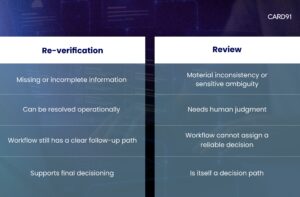
When these two get mixed, review queues fill up quickly and good cases slow down.
The best teams usually get four things right.
1. They define routing logic clearly
They avoid vague rules like “send if uncertain.”
2. They separate confidence from risk
Low confidence should not automatically mean review or rejection. This is where What Is a Confidence Score in BFSI Onboarding? Why It Matters More Than Risk Scores becomes useful.
3. They use review selectively
Review is treated as an exception layer, not the workflow’s default safety net.
4. They keep re-verification operationally clean
If a case is still recoverable, the workflow should clearly state what is missing and what needs to happen before a final decision is assigned.
Good onboarding workflow design depends on better upstream signal interpretation.
That is why Verification vs Risk Scoring vs Decisioning in BFSI: Key Differences Explained is foundational here.
If signals are fragmented or interpreted too broadly, routing breaks.
If signals are clearer, approve, review, and reject become much easier to use properly.
CARD91’s VerifyIQ fits directly into this workflow problem.
A stronger digital onboarding workflow depends on better signal interpretation, confidence-led routing, and clearer decision paths.
That is why VerifyIQ is relevant here. It helps teams move from fragmented checks to clearer workflow action.
A digital onboarding workflow should not only collect and verify information.
It should know what to do with that information next.
That is what makes onboarding scalable in BFSI.
Q: What is a BFSI onboarding workflow?
A: BFSI onboarding workflow is the routing structure that determines how a case moves through digital onboarding after inputs and signals are assessed.
Q: What are the main decision paths in digital onboarding?
A: The main decision paths are approve, review, and reject.
Q: Is re-verification a decision state?
A: No. Re-verification is a supporting operational process used when more clarity is needed before a final decision is assigned.
Q: Why is workflow design important in BFSI onboarding?
A: Because completed checks do not automatically create decision clarity. The workflow still needs to determine the right next action.
Q: How does VerifyIQ help?
A: VerifyIQ helps unify signals, improve routing precision, and support clearer onboarding decisions across approve, review, and reject paths.


To know more about our offerings connect with our experts