Subscribe to receive the latest blog posts to your inbox every week.
By subscribing you agree to with our Privacy Policy.
Decision consistency in BFSI onboarding matters because the same type of case should not lead to different outcomes just because it landed in a different queue or reached a different reviewer.
But that still happens in many onboarding workflows.
A borderline case may be approved in one queue, reviewed in another, and delayed in a third. Over time, that weakens trust in the workflow, increases operational friction, and makes onboarding quality harder to control.
For banks and NBFCs, improving decision consistency in BFSI onboarding is not just about policy. It is about stronger routing, clearer thresholds, and cleaner queue design.
Decision consistency in BFSI onboarding means similar cases are handled in similar ways across the onboarding workflow.
In practice, that means:
That matters because a strong digital onboarding workflow should not depend too heavily on queue-by-queue variation.
This is also why BFSI Onboarding Workflow Design: How Teams Should Structure Approve, Review, and Reject Decisions and Digital Onboarding Workflow Gaps: How Banks and NBFCs Can Improve Routing and Decision Quality connect closely to this topic.
Decision consistency usually weakens when workflows are not structured tightly enough.
That often happens when:
This is also why Queue Priority in BFSI Onboarding: How Ops Teams Should Triage Cases and Designing Exception Queues in Digital Onboarding: What Good BFSI Ops Teams Do Differently matter operationally.
When consistency is weak, the impact spreads quickly:
That is why consistency is not only a compliance or process issue.
It is a workflow quality issue.
Strong BFSI onboarding depends on more than speed. It depends on whether the workflow produces predictable, defensible outcomes.

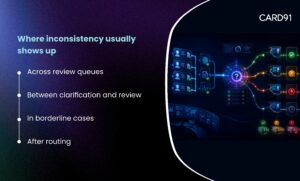
Two similar cases may get different decisions because queue handling is not aligned.
Recoverable cases may be escalated differently depending on who sees them.
If thresholds are weak, teams fill the gap with judgment, and judgment varies.
Even when cases are grouped correctly, downstream handling may still be inconsistent.
This is also why What Should Trigger Manual Review in BFSI Onboarding? A Practical Decision Framework and BFSI Onboarding Case Segmentation: How Banks and NBFCs Can Improve Speed and Control matter so much.
Approve, review, reject, and clarification should each have a clear role. Ambiguity in path design creates inconsistency later.
Cases should not be routed one way and then handled by a completely different standard downstream.
Borderline cases should not rely too heavily on individual interpretation when stronger workflow rules can handle them earlier.
Cases needing more information should not compete with decision-sensitive exceptions.
Teams should track whether similar cases are producing similar outcomes across queues.
This is also why BFSI Onboarding Operations Metrics: What Good Ops Teams Track After Onboarding is an important companion topic.
CARD91’s VerifyIQ is relevant here because stronger consistency depends on stronger upstream decisioning.
A better onboarding workflow needs clearer signal interpretation, cleaner routing, and more structured case movement before outcomes start to vary across queues.
That is why VerifyIQ fits naturally into this problem. It helps teams move from fragmented signals to cleaner workflow action.
A strong onboarding workflow should not produce different outcomes for the same kind of case.
It should produce outcomes teams can explain, repeat, and trust.
That is what better decision consistency helps BFSI teams achieve.
A: It means similar onboarding cases are handled in similar ways across queues and workflow paths.
A: Because inconsistent handling weakens trust in the workflow, increases operational friction, and reduces control.
A: Routing gaps, unclear thresholds, mixed queue logic, and too much subjectivity usually cause inconsistency.
A: No. Clarification is for recoverable cases needing more information. Review is for cases needing human judgment.
A: VerifyIQ helps improve signal interpretation and routing so cases can move through clearer, more consistent onboarding workflow paths.
To know more about our offerings connect with our experts
Sales: sales@card91.io
HR: careers@card91.io
Media: comms@card91.io
Support: support@card91.io